Monthly Archives: April 2026

How to Do a Group Taobao Order With Friends (and Why It Saves Everyone More Money)


Group Taobao order with friends saving money

The thing that finally convinced my roommate to try Taobao wasn’t any article or YouTube video. It was watching me unpack a 14-item haul on the kitchen table while she sat there buying a single top from Shein for $16. “How much was all of that?” she asked. I told her: $86 delivered. Fourteen items. She put down her phone mid-checkout.

Two weeks later we placed our first group order — her 8 items plus my 10. Same parcel, shared shipping. Her per-item shipping dropped to $1.80. She saved about $40 compared to what she would’ve spent on Shein for equivalent items. Now we order together every 6-8 weeks. Two other friends have joined since.

Group Taobao orders are the cheat code nobody talks about. Individual ordering already saves 30-50% over Western retail. Group ordering stacks another 25-40% shipping reduction on top by pushing consolidation math into territory that solo buyers can’t reach. The logistics require a little coordination, but the math is absurd.


The Math: Why Groups Win

Order type Items Weight Shipping (economy, US) Per-item shipping
Solo order (1 person) 10 ~2.5kg $22 $2.20
Duo order (2 people) 20 ~5kg $32 $1.60
Group order (3 people) 30 ~7.5kg $40 $1.33
Big group (4 people) 40 ~10kg $48 $1.20

Per-item shipping drops from $2.20 solo to $1.20 in a 4-person group. On a 40-item mega-haul, total shipping is $48 instead of $88 (four separate 10-item shipments). That’s $40 saved — $10 per person — purely from scale.

And because Fishgoo charges zero service fee, there’s no commission multiplier on the larger product total. A $300 group order pays $0 in agent fees, same as a $60 solo order. Through a 5% fee agent, that same $300 group order would cost $15 in commission — money that stays in the group’s pocket with Fishgoo.


How to Organize It: The System That Actually Works

Organizing a group Taobao order spreadsheet system

Group orders fail when they’re disorganized. They succeed when one person runs a simple system. Here’s the exact process my group uses:

Step 1: One coordinator, one account

One person creates the Fishgoo account and manages the entire order. Don’t try to use multiple accounts for one parcel — it defeats the consolidation purpose. The coordinator handles ordering, QC review, and parcel submission. Everyone else just provides their items and pays their share.

Pick the person who’s most experienced with Taobao, or the most organized. In my group, that’s me — because I’ve been doing this for 3 years and I’m the one who introduced everyone else. If you’re reading this article, that person is probably you.

Step 2: Shared spreadsheet for item collection

Create a Google Sheet with columns for: person’s name, item description, Taobao link, size (in cm), color, approximate weight, and price in ¥. Share it with the group. Set a deadline — “add your items by Sunday night, I’m ordering Monday.”

The deadline matters. Without it, people trickle in items for weeks and the order never consolidates. A hard cutoff keeps the timeline tight.

Step 3: Coordinator reviews and orders

Before ordering, the coordinator does a 30-second seller check per item — transaction count, buyer photos, basic quality signals. This catches risky purchases before they enter the group order. If someone’s item looks sketchy, flag it. “Hey, this seller has 12 transactions and no buyer photos — want to pick a different listing?”

Order all items through the single Fishgoo account. Note in the order comments which items belong to which person (for warehouse tracking).

Step 4: QC review by coordinator (with group input)

As QC photos come in, the coordinator reviews each item. For straightforward items (phone cases, socks, basics), the coordinator approves independently. For someone else’s clothing or sneakers, forward the QC photos via group chat: “Here’s your hoodie — color and size label check out. Approve or return?”

This is the one step where group participation matters. Everyone should see and approve their own items before the coordinator approves the full parcel. Five HD photos per item through Fishgoo is enough for group members to make a confident call without needing to understand the agent dashboard themselves.

Step 5: Consolidation and shipping

Once all items pass QC, the coordinator submits the consolidated parcel. Request box removal and vacuum packing to minimize weight — this benefits everyone’s per-item cost. Choose economy shipping unless the group collectively agrees on paying more for speed.

For UK/EU/Canada groups: use tax-free shipping lines. The slightly higher upfront cost prevents $15-40 brokerage fees that would otherwise need to be split across the group.

Step 6: Payment split

After the total cost is known (products + shipping + any add-ons), calculate each person’s share:

Their product cost + (their items’ weight ÷ total weight × total shipping)

In practice, most groups simplify this. My group splits shipping equally by item count rather than by weight, because the math is easier and the difference is usually $1-3 between the precise and simplified methods. Not worth arguing about.

Collect payment via Venmo, Zelle, bank transfer, or cash. Collect before ordering if you don’t fully trust everyone to pay after. In my group we settle after delivery because we’ve built trust over multiple orders.

Step 7: Distribution

Parcel arrives. Coordinator opens it with the spreadsheet open, sorts items by person, bags each person’s items separately, and distributes at the next meetup or via local dropoff. Takes 15-20 minutes. Done.


Real Example: Our Last 4-Person Group Order

Person Items Product cost Share of shipping Total
Me 10 items $62 $12 $74
Roommate 8 items $45 $10 $55
Friend A 12 items $78 $15 $93
Friend B 6 items $34 $7 $41
Total 36 items $219 $44 $263

Thirty-six items delivered for $263. Per item: $7.31. If each person had ordered individually through separate parcels, total shipping would’ve been roughly $80-90 instead of $44. The group saved $36-46 on a single order — roughly $9-12 per person.

My roommate’s 8 items for $55 total delivered. The same items from Shein would’ve cost her about $95. From local retail, $160+. She saves $40-105 by participating in a 15-minute spreadsheet exercise. The economics are silly.

Solo haul planning for comparison


Common Group Order Problems (and How We Solved Them)

Problem: Someone can’t decide and delays the whole order.
Solution: hard deadline, no exceptions. “Items in by Sunday 8 PM or they wait for the next group order.” We order monthly. Missing one deadline means a 4-week wait, which motivates timely submissions.

Problem: QC photo disagreement.
Solution: each person has final authority over their own items. If Friend A thinks their hoodie’s color is fine and you think it looks off, Friend A decides. Their money, their call.

Problem: One person’s items are all heavy and it’s unfair to split shipping equally.
Solution: if the weight disparity is extreme (someone ordered 3 winter jackets while everyone else got lightweight accessories), switch to weight-based splitting for that order. Most of the time, item-based splitting is close enough.

Problem: Someone doesn’t pay their share.
Solution: collect payment before ordering. We stopped doing this after a few successful orders, but for a new group or with acquaintances rather than close friends, upfront collection eliminates the risk entirely.

Problem: One person’s item has a problem and they want to hold the entire parcel for a return/replacement.
Solution: return the problem item, ship the rest, and the person with the returned item adds their replacement to the next group order. Don’t hold 35 items hostage for one defective hoodie.

How returns work through an agent


Scaling Up: The Semester Haul

My friend group has evolved to what we call the “semester haul” — one massive group order every 3-4 months timed to seasonal transitions. Fall wardrobe in August. Winter layers in October. Spring refresh in February. Summer stuff in April.

The semester haul typically includes 5-6 people contributing 8-15 items each. That’s 50-80 items in a single consolidated shipment. At that scale, per-item shipping drops below $1 for lightweight items. We’ve had hauls where phone cases shipped for $0.60 each.

The coordinator role rotates between the 3 most experienced members. Organizing a 60-item haul takes about 45 minutes of active work (ordering + QC review). The savings per event run $80-120 versus individual ordering. Across 4 semester hauls per year, that’s $320-480 the group keeps.

Most people in the group didn’t know what Taobao was before someone invited them into a group order. Now none of them buy basics or trend items from local retail anymore. The group order is the gateway — once someone sees the delivered cost with their own hands, they’re converted.


How to Pitch It to Your Friends

You don’t need to explain agents, Chinese platforms, or shipping logistics. You need one sentence:

“I’m placing a group order from China next week — same stuff as H&M but 60% cheaper. Send me links of anything you want and I’ll handle the rest. You just pay your share via Venmo.”

That’s it. You’re the coordinator. They just send links (found through image search or your guidance) and pay. The barrier to entry for a group participant is near zero — no account creation, no learning curve, no Chinese language. They experience the savings on someone else’s infrastructure, and then they understand.

After 1-2 group orders, at least one of them will ask: “Can I set up my own account?” At which point you send them the first order checklist and they become an independent Taobao buyer. The group order is simultaneously a savings mechanism and a user acquisition funnel — for the platform, for the agent, and for the concept of buying from China.


FAQ

  • Do we all need Fishgoo accounts?

    No. One account, one coordinator. Everyone else just submits their item preferences and pays their share. Only the coordinator interacts with Fishgoo.

  • What’s the ideal group size?

    3-5 people. Below 3, minimal improvement over solo ordering. Above 5, coordination becomes burdensome. 4 is the sweet spot — large enough for shipping scale, small enough to manage.

  • Can we ship to different addresses?

    The parcel ships to one address — the coordinator’s. Distribution happens in person or via local delivery. Splitting into multiple parcels to different addresses defeats the consolidation purpose and multiplies shipping costs.

  • How do we handle different size and quality preferences?

    Each person selects their own items, sizes, and quality tiers. The coordinator orders exactly what each person specifies. QC photos let each person approve their specific items. Individual preferences don’t affect the group logistics.

  • What if I’m the only one who knows about Taobao?

    Perfect — that makes you the natural coordinator. Start with one friend. Place a duo order. Show them the savings. They’ll recruit the third person. Organic growth is how every group order circle starts.


→ Start your group order with Fishgoo — zero fee, one account for everyone

→ Haul planning basics

→ 9 money-saving tactics

→ First order checklist

→ Complete agent overview

→ Best agent 2026

What NOT to Buy on Taobao: 8 Categories Where the Savings Aren’t Worth It


What not to buy on Taobao product categories to avoid

I’ll recommend Taobao shopping to anyone who asks. But I’m not going to pretend everything on the platform is a smart purchase. It’s not. Out of the billion-plus listings on Taobao, there are categories where the savings aren’t worth the safety risk, the customs hassle, or the practical headache.

It took me about $150 in lessons to learn these boundaries. A wall charger that got warm enough to smell like burning plastic. A food order that got seized by customs and took my two hoodies hostage in the same parcel. A “prescription equivalent” pair of contact lenses that made my eyes itch for a week. Each mistake taught me where the line is between “great deal” and “not worth it at any price.”

This list draws the line clearly. Eight categories to avoid or approach with extreme caution — with the specific reasoning behind each one so you understand the principle, not just the rule.

For everything that IS great to buy: best things to buy on Taobao


#1: Mains-Voltage Electronics (Wall Chargers, Power Banks, Adapters)

Electronics safety concerns buying from Taobao

This is the most important item on the list. Low-voltage accessories — phone cases, USB cables, earbuds, LED strips, desk fans — are completely fine from Taobao. They operate at 5-12 volts. A failure means the device stops working. Annoying, not dangerous.

Mains-voltage items are different. Wall chargers, power adapters, power banks, extension cords, and anything that plugs directly into your wall socket operates at 110-240 volts. A failure at mains voltage can cause electrical fire, shock, or worse. These products need safety certifications (UL for US, CE for EU, SAA for Australia) that verify internal protection circuits, fire-resistant materials, and overload safeguards.

Most Taobao sellers manufacturing for the domestic Chinese market don’t carry export-market certifications. The charger works — until it doesn’t. And when a mains-voltage device fails without proper protection circuits, the failure mode is heat, sparks, or fire, not just a dead device.

I used a Taobao wall charger for about three months before it started getting noticeably warm during charging. Warm chargers are the warning sign before melting chargers. Threw it away immediately, bought a certified Anker from Amazon for $12, and never sourced mains-voltage electronics from Taobao again. That $8 savings wasn’t worth the risk to my apartment.

The rule: If it plugs into a wall socket, buy certified from a trusted brand. If it plugs into a USB port, Taobao is fine.

Full electronics buying safety breakdown


#2: Medications, Supplements, and Health Products

Chinese pharmaceutical products are manufactured under China’s regulatory framework, which doesn’t align with FDA (US), MHRA (UK), or TGA (Australia) standards. This isn’t a quality judgment — it’s a regulatory reality. Supplements that are legal and regulated in China may contain ingredients that are restricted or untested in your country.

Three specific risks:

Ingredient uncertainty. Chinese supplement labeling is in Chinese, under Chinese ingredient standards. A “herbal supplement” may contain compounds that interact with medications you’re taking. Without English-language labeling and your country’s regulatory review, you don’t know what you’re ingesting.

Customs seizure. Most countries classify imported medications and supplements as controlled goods. Customs can seize them, and the seizure sometimes flags your entire parcel for inspection — meaning your clothing and accessories in the same shipment get delayed or held too.

No recourse. If a health product causes an adverse reaction, there’s no regulatory body to report to, no recall mechanism, and no liability framework that crosses international borders.

The rule: Buy health products from pharmacies in your own country. The regulatory framework exists for a reason.


#3: Food and Perishables

I learned this one the expensive way. Ordered some Chinese snacks alongside a regular clothing haul. Customs inspected the parcel, found food products without English ingredient labels, seized the food — and held the entire parcel for 10 days while they processed the seizure. My hoodies were hostage because of some dried plums.

Food import regulations exist in virtually every country. Meat products, dairy, fresh produce, and items without bilingual labeling are routinely seized. Even shelf-stable snacks are a gamble depending on the customs agent who happens to inspect your parcel.

The risk-reward math is terrible: $5 in snacks puts a $100 clothing haul at risk of delays or seizure. Not worth it.

The rule: Never mix food with non-food items in the same parcel. Better yet, skip food entirely and buy Asian snacks from a local Asian grocery store — they’ve already cleared import regulations.

What to do if customs holds your parcel


#4: Safety-Critical Car Parts

Brake pads, brake rotors, airbag components, tire pressure sensors, steering parts. Anything where a product failure could directly cause an accident.

Cheap car parts from unverified Chinese sellers may look identical to certified parts but lack the material specifications, heat treatment, or quality testing that prevents failure under stress. A $15 brake pad that works fine for 6 months and then disintegrates during hard braking is not a savings — it’s a catastrophe.

Non-safety car parts are a different story. Interior trim, LED interior lights, phone mounts, seat covers, floor mats — these are perfectly fine from Taobao. A failing seat cover is inconvenient. A failing brake pad is life-threatening.

The rule: Interior and cosmetic car parts → Taobao is fine. Anything in the braking, steering, suspension, or airbag system → buy certified from auto parts retailers.


#5: Children’s Products Requiring Safety Certification

Children’s products are held to specific safety standards in most countries — CPSIA in the US, EN 71 in Europe, AS/NZS in Australia. These cover lead content in paint, choking hazard assessment, flammability of fabric, and structural integrity of cribs, car seats, and similar items.

Children’s clothing from Taobao is generally fine — fabric composition doesn’t change based on the wearer’s age. But toys with small parts, baby items with structural safety requirements (high chairs, strollers, car seats), and children’s jewelry or accessories with potential lead-containing paint should be sourced from certified retailers.

The risk is specific: a $4 Taobao toy with lead paint poses no danger to an adult buyer but genuine risk to a child who puts it in their mouth. Savings of $10-20 on a toy don’t justify unknown material safety.

The rule: Children’s clothing → fine. Children’s toys, furniture, or items with paint/small parts → buy certified locally.


#6: Contact Lenses and Prescription Eyewear

Colored contact lenses are hugely popular on Taobao, especially for cosplay. But contact lenses sit directly on your cornea. Improperly manufactured lenses — wrong curvature, poor oxygen permeability, contaminated packaging — can cause corneal abrasion, infection, or permanent vision damage.

Legitimate contact lens manufacturers produce under strict medical device standards with sterile packaging and validated curvature specifications. Random Taobao sellers offering $3 colored contacts are almost certainly not manufacturing under those standards.

My one experience with Taobao contact lenses ended after three days of itchy, red eyes. An optometrist visit later: minor corneal irritation from lenses with incorrect base curve. The $3 lens savings cost me a $120 doctor’s appointment.

The rule: Contact lenses from an optometrist or licensed online retailer only. No exceptions, no matter how good the cosplay deal looks.


#7: Lithium Batteries Shipped Alone

International shipping carriers classify lithium batteries as dangerous goods. Most carriers allow lithium batteries contained inside a device (your phone, laptop, etc.) but restrict or prohibit standalone lithium batteries, power banks over certain capacities, and loose battery cells.

If you order standalone lithium batteries from Taobao, one of three things happens: the agent can’t find a carrier willing to ship them (order stuck), the carrier confiscates them during handling (lost money), or they get flagged at customs (potential parcel seizure). All bad outcomes.

Power banks under 100Wh (roughly 27,000mAh) can sometimes ship via specific carriers, but it depends on the route, the carrier’s current policy, and sometimes the mood of the inspector. Not reliable enough to recommend.

The rule: Don’t order standalone batteries or high-capacity power banks from Taobao. Buy locally where shipping isn’t a factor.


#8: Items That Absolutely Must Be Tried On

This isn’t a safety issue — it’s a practical one. Some items fundamentally require physical fitting that QC photos and cm measurements can’t replace:

  • Wedding dresses. Millimeter-level fit matters. Alterations are expected. This is a local bridal shop purchase, not a Taobao gamble.
  • Prescription eyeglasses. Pupillary distance, lens curvature, frame fit on your specific face shape — too many variables for remote purchasing.
  • Orthopedic or specialty shoes. If you need specific arch support, wide widths, or accommodations for foot conditions, physical fitting is essential.
  • Custom-tailored formal wear. A suit that needs to fit perfectly is worth the local tailor premium.

Regular clothing, casual shoes, accessories — all absolutely fine from Taobao with QC photos and proper sizing. It’s only the categories where imperfect fit creates significant cost or discomfort that justify the local premium.

When to buy local vs Taobao — full comparison


The Flipside: Everything Else Is Fair Game

Eight categories to avoid out of a billion-plus listings. That means 99.9% of Taobao’s catalog is perfectly fine for international buyers — with proper seller verification and QC inspection.

The categories where Taobao excels are vast:

The “what not to buy” list is short precisely because Taobao is genuinely excellent for the vast majority of product categories. The eight exceptions are about safety and regulatory boundaries, not about platform quality.

Best things to buy on Taobao — full category list


FAQ

  • Is all Taobao electronics dangerous?

    No. Low-voltage electronics (USB-powered devices, phone accessories, earbuds, LED lights, desk fans) are fine. Only mains-voltage items (wall chargers, power adapters, extension cords) carry meaningful safety risk due to lack of export-market certification.

  • Can I buy skincare from Taobao?

    From Tmall flagship stores with brand authorization — yes, same products as your local Sephora at Chinese retail prices. From random Taobao sellers with suspiciously low prices — risky, unknown ingredients, skip it.

  • What if I accidentally order a restricted item?

    Your agent may flag it during purchasing. If it reaches the warehouse, it might be flagged during consolidation. If it ships, customs may inspect and seize the item — potentially delaying your entire parcel. The safest approach is to not include restricted items in hauls containing products you actually need.

  • Are Taobao products safe in general?

    Yes — the 8 categories on this list are specific exceptions, not the norm. Clothing, accessories, bags, phone cases, stationery, home goods, and most other categories are perfectly safe and represent genuinely excellent value through an agent like Fishgoo.

    Is using a Taobao agent safe?


→ Shop what Taobao does best — Fishgoo, zero fee, 5 QC photos

→ Best things to buy on Taobao

→ 12 common mistakes to avoid

→ First order checklist

→ Complete agent overview

→ Is an agent worth it?

Taobao Agent Hidden Costs: Every Fee Explained, Including the Ones Nobody Talks About


Taobao agent hidden costs and fees explained

When I switched from Superbuy to Fishgoo last year, I expected to save money on service fees. Zero percent versus five percent — obvious win. What I didn’t expect was that service fees were only one of four cost layers I’d been paying. Two of the other layers were visible if you looked carefully. One was almost invisible.

That invisible layer — exchange rate markup — was quietly adding 3-4% to every order I placed. Not on any invoice. Not in any fee disclosure. Just baked into the currency conversion so that ¥100 worth of products cost me $14.30 instead of the $13.89 I’d pay at the actual interbank rate. On my $2,400 annual spend, that invisible markup was costing me roughly $70-95 per year. On top of the $120 in explicit service fees I was already annoyed about.

This article peels apart every cost layer in agent-based Taobao shopping. Not to scare you — the total cost is still dramatically lower than buying from AliExpress or local retail. But you deserve to know exactly where every dollar goes so you can make informed decisions instead of trusting marketing claims.


The Four Cost Layers

Every Taobao agent order involves four cost components. Two are obvious. Two are quiet. All four contribute to your total cost of ownership.

Cost layer Visibility Range Who controls it
1. Product price Fully visible Set by Taobao seller You (by choosing seller/product)
2. Service fee Fully visible 0-5% of product cost Agent
3. International shipping Visible but complex $14-65 per parcel Agent + carrier + you (by choosing method)
4. Exchange rate margin Mostly invisible 1-5% above interbank rate Agent

Let me break each one down with real numbers.


Layer 1: Product Price — The Same Everywhere (Mostly)

The actual price of the item on Taobao or 1688. This is set by the Chinese seller, not your agent. It should be identical regardless of which agent you use — they’re all buying from the same listing.

I say “mostly” because there’s one exception: some agents round product prices up slightly during conversion. Instead of showing you the exact ¥79 price as $10.97 (at real exchange rate), they might show it as $11.20 or $11.50. This is technically part of the exchange rate margin, but it starts at the product price display level, which makes it harder to catch.

How to verify: Open the original Taobao listing. Note the ¥ price. Divide by the current USD/CNY exchange rate (check Google: “1 USD to CNY”). Compare that number to what your agent shows. If the agent’s number is more than 2% higher, the markup is aggressive.

How the Taobao purchasing process works


Layer 2: Service Fee — The Visible Differentiator

Taobao agent service fee comparison chart

This is the one agents compete on publicly. It’s a percentage charged on the product price as commission for the purchasing service.

Agent Advertised fee On a $100 order Annual cost ($2,000 spend)
Fishgoo 0% $0 $0
CSSBuy ~3-4% $3-4 $60-80
Sugargoo ~5% $5 $100
Superbuy ~5% $5 $100
Pandabuy ~5% $5 $100

This layer is straightforward: zero is less than five. On a $2,000 annual spend, the service fee difference between Fishgoo and a 5% agent is $100 per year. That’s real money — enough for 2-3 extra hauls worth of products.

But here’s what most comparison articles miss: service fee is only one of four layers. An agent advertising “zero service fee” could theoretically recoup the difference through aggressive exchange rate markup or inflated shipping rates. That’s why you need to evaluate all four layers together, not just the headline number.

Full fee comparison breakdown


Layer 3: International Shipping — Visible but Complex

You see the shipping cost before you pay it, so it’s technically visible. But the pricing structure is complex enough that most buyers can’t tell whether they’re getting a fair rate or an inflated one.

How agents price shipping

Agents negotiate volume contracts with international carriers (DHL, EMS, China Post, YTO, etc.). These contracts give them rates significantly below what an individual shipper would pay. The agent passes through a portion of the discount to you and keeps a margin — typically 15-30% above their cost.

This is entirely normal and fair. The agent is providing a service (consolidation, customs documentation, carrier selection), and the shipping margin is one of their revenue sources. The question isn’t whether they add margin — it’s how much.

How to evaluate shipping fairness

Compare quotes across agents for the same parcel. Estimate your parcel weight (roughly 200-300g per clothing item, 600-900g per pair of shoes). Check 2-3 agents’ shipping calculators for the same weight to the same destination. If one agent consistently quotes 30-50% higher than others for identical routes, their shipping margin is aggressive.

Check route availability. More routes = more competition = better rates for you. Fishgoo‘s 2,000+ routes mean you almost always have 4-6 competitive options for any destination. Agents with fewer routes give you less choice and less leverage.

Watch for “shipping insurance” auto-enrollment. Some agents automatically add $2-5 shipping insurance to your order. It’s opt-out, not opt-in, and easy to miss in the checkout flow. Check whether insurance is pre-selected before submitting your parcel.

Shipping methods and rates compared


Layer 4: Exchange Rate Margin — The Quiet One

Exchange rate margin comparison between Taobao agents

This is the fee most people never notice. When you pay in USD (or EUR, GBP, AUD) and the agent purchases in CNY, there’s a currency conversion. The agent sets the conversion rate — and every agent sets it higher than the actual interbank rate.

The interbank rate is what banks exchange at. As of writing, roughly 1 USD = 7.20 CNY. If your agent converts at 1 USD = 7.05 CNY, they’re adding approximately 2.1% margin. That means your $100 product order actually costs you $102.10 before any other fees.

Let’s see how this plays out across different margin levels:

Exchange rate margin Cost on $100 order Annual cost ($2,000 spend)
~1-1.5% (Fishgoo) $1.00-1.50 extra $20-30
~2-3% (typical agent) $2.00-3.00 extra $40-60
~4-5% (aggressive agent) $4.00-5.00 extra $80-100

On a $2,000 annual spend, the difference between a 1.5% and a 4% exchange rate margin is $50-70 per year. Combined with service fee differences, the total cost gap between the cheapest and most expensive agents can reach $150-200 annually — on the exact same products purchased from the exact same sellers.

How to check your agent’s exchange rate

This takes 30 seconds:

  1. Note a product’s price in ¥ on the Taobao listing (example: ¥72)
  2. Google “72 CNY to USD” — this gives you the interbank rate (example: $10.00)
  3. Check what your agent charges for the same item in USD (example: $10.30)
  4. The difference ($0.30 on $10.00 = 3%) is the exchange rate margin

Do this once and you’ll know your agent’s typical margin. It doesn’t change often — agents set their conversion formula and keep it consistent.


Optional Add-On Charges

Beyond the four core layers, most agents offer paid add-ons. These are legitimate services with real costs — the question is whether you need them.

Extra QC photos. Some agents charge $0.30-1.00 per additional photo beyond the free allotment. Fishgoo includes 5 free HD QC photos per item — enough for thorough inspection in most cases. Agents offering only 3 free photos push you toward paying for the 4th and 5th.

Detailed measurement requests. Asking the warehouse to measure the actual insole length, chest width, or sleeve length of your item. Usually $0.50-1.00 per measurement. Worth it for items where size chart accuracy is critical — sneakers, tailored clothing.

Shipping insurance. $1-3 per parcel. Covers loss or damage during transit. Whether you need this depends on the parcel value. On a $50 haul, probably skip it. On a $200 premium haul, worth considering.

Priority processing. $2-5 to have your parcel consolidated and shipped before other orders in the queue. Only useful during peak seasons (post-11.11, pre-Christmas) when processing queues stretch to 3-5 days instead of the usual 1-2.

Vacuum packing / special packaging. $1-3 per parcel. Reduces volumetric weight significantly. Can actually save you more on shipping than the packaging costs, especially for bulky clothing items. Often a net positive expense.

None of these are hidden — they’re presented as options during checkout. The “hidden” cost risk comes from auto-selected add-ons you didn’t notice. Always review the order summary line by line before paying.


The True Total Cost: Side-by-Side Example

Let me build a complete cost comparison for a typical 10-item haul ($80 in products, 2.5kg, shipped economy to the US):

Cost layer Fishgoo Agent charging 5% + 3% FX Difference
Product cost $80.00 $80.00 $0
Service fee $0 $4.00 (5%) +$4.00
Exchange rate margin (~1.5% vs ~3%) $1.20 $2.40 +$1.20
Shipping (economy, 2.5kg) $22 $25 +$3.00
Add-ons (none selected) $0 $0 $0
Total delivered $103.20 $111.40 +$8.20

$8.20 per haul doesn’t sound dramatic. But do 5 hauls per year and it’s $41. Do it for 3 years and it’s $123. And that’s on moderate $80 orders — on larger orders, the percentage-based fees scale proportionally.

More importantly: the $103.20 total through Fishgoo for 10 items delivered is still 50-65% less than what those same items would cost from AliExpress ($160-190) or local retail ($250-400+). Agent costs exist, but even with all four layers fully accounted for, the Taobao agent route remains dramatically cheaper than every alternative.

Full savings optimization with 9 tactics


How to Minimize Your Total Agent Cost

Five actions that push all four layers as low as possible:

1. Choose a zero-fee agent. Eliminates Layer 2 entirely. Fishgoo is currently the only major agent offering genuine zero service fee.

2. Check the exchange rate once. Compare your agent’s conversion to the interbank rate. If the margin is above 2%, you’re overpaying on Layer 4. Switch to an agent with tighter FX spread.

3. Consolidate 8-12 items per parcel. Spreads the Layer 3 shipping base rate across more items. Per-item shipping drops from $14 to $2-3.

4. Choose economy shipping. Reduces Layer 3 by 50-65% versus express. The speed difference is 10-15 extra days.

5. Review checkout line items before paying. Catch any auto-selected add-ons you don’t need. Deselect insurance on low-value orders. Skip priority processing unless you’re genuinely in a rush.

With all five actions applied, your agent-related costs on an $80 product order come to roughly $23 (Fishgoo: $0 fee + $1.20 FX + $22 shipping). That’s a 29% overhead on products — which sounds high until you remember that the alternative is paying 50-80% more on English-facing platforms where the overhead is baked into inflated product prices and invisible.


The Transparency Test

A trustworthy agent shows you every cost before you commit. Run this checklist:

  • ✅ Service fee percentage clearly stated (or confirmed as zero)
  • ✅ Shipping quote provided before you pay for shipping
  • ✅ Product prices match original Taobao listing (within ~2% for FX)
  • ✅ Add-ons are opt-in, not pre-selected
  • ✅ No “processing fee,” “handling fee,” or vague charges on the invoice

If any of these fail, the agent is using opacity as a revenue strategy. Move to one that doesn’t.

Agent legitimacy verification

Is using a Taobao agent safe?


FAQ

  • Is “zero service fee” a marketing trick?

    Not at Fishgoo. The service fee is genuinely zero — the $0 line item is real. Fishgoo earns through shipping margin and exchange rate margin (approximately 1-1.5%), which is transparent and lower than most competitors’ exchange rate spreads even before their additional service fees. The total cost comparison confirms this — Fishgoo’s all-in price consistently comes out lowest.

  • Which cost layer matters most?

    Shipping (Layer 3) is the largest absolute cost. Service fee (Layer 2) and exchange rate margin (Layer 4) are the most controllable — you can eliminate or minimize both by choosing the right agent. Product price (Layer 1) is fixed by the seller.

  • How much does the average Taobao buyer actually spend on agent costs?

    On a zero-fee agent like Fishgoo with economy shipping: roughly $20-30 per haul in shipping plus $1-2 in exchange rate margin. On a 5% fee agent with similar shipping: $25-35 plus $4-8 in fees and FX margin. Annual difference for a regular shopper: $50-150.

  • Should I worry about exchange rate margins?

    Check it once. If your agent’s margin is below 2%, it’s competitive. If it’s above 3%, you’re paying a premium that compounds over time. Most established agents fall in the 1.5-3% range. Fishgoo sits at the lower end (~1-1.5%).

  • Are there any completely hidden fees I might miss?

    The main one people miss is exchange rate margin — it never appears as a line item. Auto-selected insurance is the other common surprise. Beyond those, legitimate agents don’t have hidden fees. If you see unexplained charges on an invoice, contact the agent’s support and ask. If they can’t explain a charge clearly, that’s a red flag.


→ See the real cost yourself — Fishgoo zero fee, transparent pricing

→ Is an agent worth it for your situation?

→ Agent fee comparison

→ Cheapest Taobao agent

→ Complete agent overview

→ Best agent 2026

→ First order checklist

Taobao vs Buying Local: When Cheap Chinese Prices Actually Beat the Mall (and When They Don’t)


Taobao vs local retail shopping comparison

My sister asked me last Thanksgiving why I was wearing a jacket she’d never seen before. I told her it was from Taobao. Cost me $22 delivered. She looked at it, felt the fabric, checked the stitching, and said: “I almost bought the same jacket at Nordstrom Rack for $89. This looks identical.”

Then she paused. “But I would’ve had it the same day.”

That pause — the moment where the price advantage collides with the convenience gap — is the real decision point. And it’s more nuanced than either side wants to admit. Taobao evangelists (including me, sometimes) act like paying retail is always irrational. Local retail defenders act like waiting 3 weeks for delivery is always unacceptable. Neither position is honest.

The truth is that both options have legitimate advantages, and a smart shopper uses each one where it actually wins. This article maps out exactly where each one wins, with real cost comparisons and no pretending that one answer fits every situation.


The Cost Comparison Nobody Puts in Writing

Let me build a realistic 10-item seasonal wardrobe and price it across three channels:

Item Taobao (via Fishgoo) Fast fashion (H&M/Zara) Mid-range (COS/Nike)
2 plain hoodies $14 $50-60 $80-120
3 t-shirts $9 $30-45 $60-90
1 jacket $22 $60-90 $120-180
1 pair pants $10 $35-50 $60-90
1 crossbody bag $5 $25-40 $50-80
2 accessories $4 $15-25 $30-50
Product subtotal $64 $215-310 $400-610
Shipping $26 $0 (in-store) $0 (in-store)
Agent fee (Fishgoo) $0
Total $90 $215-310 $400-610

Taobao saves $125-220 versus fast fashion. $310-520 versus mid-range. On the same products, from the same factories, with equivalent quality tiers.

Do that 3-4 times per year (seasonal refreshes) and the annual savings range from $500 to $2,000. That’s rent money. That’s a vacation. That’s real financial impact from a shopping habit change.

Full savings breakdown with 9 tactics


Where Taobao Wins Clearly

Basics and staples you buy repeatedly

Plain t-shirts, hoodies, joggers, underwear, socks, phone cases, tote bags. Items where brand doesn’t matter and you just want the product at the lowest cost. The price gap is widest here — Taobao basics cost 60-80% less than equivalent mall basics.

I haven’t bought a plain t-shirt from a local store in two years. Taobao tees at $3 each are indistinguishable from $15 H&M tees once you’re past mid-tier quality. I buy 10 at a time in a haul, they arrive in 3 weeks, and I’m set for months.

Trend items with short shelf life

That viral jacket everyone’s wearing on TikTok. The specific bag shape that’s trending this season. Micro-trends that’ll be over in 4-6 months. Paying $60-90 at Zara for something you’ll wear one season makes zero sense when the same item is $12-25 on Taobao from the same manufacturer.

Niche items local stores don’t carry

Cosplay costumes, anime collectibles, specific sneaker styles, 925 silver jewelry at factory prices, hobby supplies, niche stationery. These categories simply don’t exist in most local retail environments, or they exist at 3-5x the price through specialty importers who source from the same Chinese suppliers.

Gift buying in bulk

Holiday gifts, party favors, wedding accessories, team merchandise. When you need 10-20 of something, the per-unit savings compound dramatically. Through 1688 wholesale, you can source 20 gifts for the price of 3-4 at local retail.


Where Local Shopping Wins Clearly

Urgency — you need it today

Job interview tomorrow and you need a shirt. Date tonight and you want new shoes. Kid’s school event this afternoon. No amount of Taobao savings helps when the delivery window is 2-4 weeks and your need is right now.

I keep a mental separation: planned purchases go through Taobao, urgent purchases go to local stores. The ratio is about 80/20 in favor of Taobao because most clothing needs are actually plannable — you know winter is coming, you know you need work shirts eventually. Urgency purchases are rarer than they feel.

Fit-critical items you must try on

Formal suits, bras, shoes with specific arch support requirements, items where a half-size difference ruins the fit. Centimeter measurements and QC photos handle most sizing needs, but there are categories where physically trying something on before buying is genuinely valuable. Wedding dresses, tailored blazers, orthopedic shoes — buy these locally.

Products needing local warranty or support

Laptops, smartphones, major appliances, anything where you might need to walk into a store for warranty service. Chinese electronics work fine globally, but getting warranty support for a Taobao-sourced laptop in Ohio is… not practical. For high-ticket electronics, buy locally for the support infrastructure.

The shopping experience itself

Sometimes shopping isn’t about the product — it’s about the experience. Weekend mall trip with friends. Browsing a vintage market. Trying on 15 things and laughing at the terrible ones. That’s genuine entertainment that online shopping can’t replicate. When the goal is experience rather than acquisition, local wins by definition.


The Hybrid Model: What Smart Shoppers Actually Do

Smart hybrid shopping model combining Taobao and local

The best approach isn’t “only Taobao” or “only local.” It’s a deliberate split based on what each channel does best:

Category Buy from Why
Basics and staples Taobao 60-80% savings, no brand value in basics
Trend/seasonal items Taobao Short lifespan doesn’t justify retail markup
Niche hobby items Taobao/Weidian Not available locally or 3-5x cheaper
Gifts in quantity Taobao/1688 Per-unit savings compound at volume
Urgent needs Local Same-day availability
Fit-critical formal wear Local Must try on
Electronics with warranty Local/Amazon Support infrastructure
Investment pieces Either Local if you can try on, Taobao premium tier if you trust QC

My personal split: roughly 70% of my clothing and accessories budget goes through Fishgoo, 30% goes to local stores. That 70/30 split saves me approximately $1,200 per year compared to buying everything locally. The 30% local portion covers urgent needs, formal wear, and the occasional mall trip where the point is hanging out, not shopping efficiently.


The Hidden Costs of Local Shopping Nobody Counts

When people compare Taobao to local shopping, they compare product price + shipping against product price. That’s incomplete. Local shopping has costs that never show up on the receipt:

Transportation. Gas, parking, transit fare. A mall trip costs $5-15 in transportation depending on where you live. Multiply by 12-24 shopping trips per year and it’s $60-360 annually in getting to the store.

Time. A typical mall shopping trip takes 2-4 hours including travel. A Taobao ordering session takes 20-40 minutes from your couch. If your time has any value at all, the efficiency gap is massive.

Impulse purchases. Malls are architecturally designed to make you buy things you didn’t plan to. The average mall visit results in 1.5 unplanned purchases. Over a year, impulse buys at retail markup add hundreds of dollars you wouldn’t have spent shopping from home.

Return trips. Wrong size from a local store? Drive back to return it. Another 30-60 minutes plus transportation costs. On Taobao with an agent, returns happen at the warehouse before the item ever crosses an ocean — no trip needed.

When you factor in these hidden costs, the real gap between Taobao and local shopping widens by another 15-25% in Taobao’s favor.


FAQ

  • Is Taobao quality as good as H&M or Zara?

    At the mid-tier price range ($8-25), yes. Many Western fast-fashion brands source from the same Chinese factories that sell on Taobao. The quality difference between a $15 Taobao hoodie and a $45 H&M hoodie is the label and retail markup, not the fabric or construction.

  • What’s the biggest downside of Taobao vs local?

    Delivery time. Taobao orders take 2-4 weeks from order to doorstep. If you need something immediately, local stores win on speed alone. Plan ahead and this downside disappears.

  • Can I return Taobao items if they don’t fit?

    Before international shipping: yes, free returns within China through your agent. After delivery: difficult and often not cost-effective. This is why QC photos and cm sizing matter — catch fit issues before shipping.

  • Should I switch entirely to Taobao?

    No. A 70/30 Taobao-to-local split captures most savings while preserving local shopping for categories where it genuinely wins (urgency, try-on, warranty). Pure Taobao shopping misses the legitimate advantages of physical retail.

  • How do I start?

    Move your next planned staples purchase to Taobao. Sign up for Fishgoo, order 8-10 basic items, receive in 3 weeks. Compare quality and cost against what you’d have paid locally. That single comparison tells you whether the switch makes sense for your specific shopping patterns.

    First order checklist


→ Start your first Taobao order — zero fee, see the savings yourself

→ Is an agent worth it for your situation?

→ 9 money-saving tactics

→ Complete agent overview

→ Best agent 2026

→ How to plan a haul

12 Taobao Mistakes That Cost Real Money (I Made Most of Them So You Don’t Have To)

Common Taobao shopping mistakes to avoid

Over three years of Taobao shopping, I’ve tracked every mistake I’ve made and roughly how much each one cost me. The total? Somewhere around $600 in wasted money, unwearable items, unnecessary shipping costs, and returns I could have avoided with 30 seconds of prevention. Six hundred dollars that simply evaporated because I didn’t know what I didn’t know.

The frustrating part: every single mistake on this list is completely avoidable. None of them are obscure edge cases or bad luck. They’re the same predictable errors that nearly every new Taobao buyer makes, in roughly the same order, for roughly the same reasons. This list exists so you can skip the $600 learning curve and go straight to the part where Taobao shopping actually works the way it’s supposed to.

Ranked by how much money each mistake typically costs, from most expensive to least.


Mistake #1: Shipping Items One at a Time — Cost: $8-14 Per Item Wasted

The most expensive mistake by far, and the one almost every beginner makes. You find one cool hoodie, order it, ship it alone. The hoodie costs $8. Shipping costs $14. You paid more in shipping than in product.

Meanwhile, that same hoodie consolidated with 9 other items would’ve cost $2.80 to ship. You wasted $11.20 on a single unnecessary shipment. Do that 5 times across your first year and you’ve thrown away $56 in pure shipping excess.

The fix: Never ship fewer than 8 items. If you only have 3-4 items ready, use Fishgoo’s 100-day free warehouse storage and wait until you’ve accumulated more. The consolidation math is unforgiving on small parcels and spectacularly generous on big ones.


Mistake #2: Trusting Letter Sizes Instead of Centimeters — Cost: $15-40 Per Wrong Item

Chinese “L” is roughly Western “S.” Chinese “XL” is roughly Western “M.” If you order your usual letter size from Taobao, you will receive something too small. This isn’t a maybe — it’s a certainty.

A wrong-size item costs you the product price (usually non-refundable after international shipping) plus the replacement order. On a $20 jacket, that’s $40 total for one wearable item instead of $20.

The fix: Measure yourself in centimeters. Match to the seller’s cm size chart. Ignore the letter. Every time, no exceptions.


Mistake #3: Skipping QC Photo Review — Cost: $20-60 Per Undetected Defect

You get the notification that items arrived at the warehouse. You’re excited. You click “ship everything” without looking at the QC photos. Two weeks later a stained hoodie, a wrong-color bag, and a pair of sneakers with mismatched toe boxes arrive at your door.

Each of those was visible in the QC photos you didn’t check. Each could’ve been returned within China for free. Instead, you’re stuck with $45 worth of items you’ll never wear, and international return shipping would cost more than the items are worth.

The fix: Spend 2 minutes per item reviewing QC photos. Fishgoo gives you 5 free HD photos — enough to catch color, construction, sizing, and defect issues. Those 2 minutes save you $20-60 per catch.


Mistake #4: Using a High-Fee Agent for Multi-Item Orders — Cost: $40-150 Per Year

A 5% service fee sounds negligible on a single $10 item. But across a year of regular shopping — say $1,500-3,000 in total purchases — that’s $75-150 in pure agent commission. For the exact same service you could get at zero percent through Fishgoo.

I spent $120 in agent fees in 2024 before switching. That $120 is now buying me products instead of subsidizing someone else’s business model.

The fix: Use a zero-fee agent. The service is identical. The savings compound with every order. Fee comparison details here.


Mistake #5: Ignoring Buyer Review Photos — Cost: $10-30 Per Surprise

Seller listing photos are marketing materials. They’re shot in studios with professional lighting, color grading, and sometimes outright Photoshop. Buyer review photos show the actual product under real-world conditions.

I once ordered a “vintage brown leather” bag that turned out to be orange plastic. Every buyer photo showed the orange plastic. I just never scrolled down to look.

The fix: Before adding any item to cart, spend 30 seconds looking at 5+ buyer-uploaded photos. If the buyer photos don’t match the listing, the buyer photos are reality.


Mistake #6: Ordering During Chinese New Year Without Knowing — Cost: 2-4 Weeks of Delays

Mid-January through mid-February, Chinese factories and warehouses close for 1-2 weeks. If you place orders during this window, items sit in limbo. Sellers don’t ship. Agents operate skeleton crews. International carriers are backlogged from the pre-CNY rush.

I once waited 6 weeks for a haul that would normally take 3 weeks because I ordered on January 28 without checking the sale calendar.

The fix: Avoid ordering January 15 through February 20. If you must order, accept 2-4 weeks of additional delay.


Mistake #7: Not Using Tax-Free Shipping Lines in UK/EU/Canada — Cost: $15-40 Per Parcel

If you’re in the UK, EU, or Canada and you ship via a non-tax-free line, you’ll get hit with VAT/duty charges PLUS a courier brokerage fee of $15-40 on delivery. That brokerage fee can double your effective shipping cost on a small parcel.

Tax-free lines cost maybe $5-10 more upfront but prevent the $15-40 surprise. Net savings every time.

The fix: When selecting shipping at consolidation, specifically choose a line labeled “tax-free” or “tax-included.” Fishgoo offers multiple tax-free routes for these regions.


Mistake #8: Buying Without Checking Seller Transaction Count — Cost: $10-50 Per Risky Purchase

A seller with 15 transactions on a specific product is unproven. A seller with 2,000 transactions on the same product has been validated by 2,000 buyers. The probability of getting a bad product drops dramatically with higher transaction counts.

The fix: Minimum 500 product-level transactions for your first few orders. For premium items over $40, aim for 1,000+.


Mistake #9: Keeping Shoe Boxes When Shipping — Cost: $8-15 Per Pair in Extra Shipping

Shoe boxes weigh 400-600g and take up enormous volumetric space. On a pair of sneakers, keeping the box can add $8-15 to shipping costs. That decorative box is going straight into your recycling bin anyway.

The fix: Request box removal during consolidation. Items get bubble-wrapped individually instead. Same protection, fraction of the weight.

Sneaker shipping optimization


Mistake #10: Defaulting to Express Shipping — Cost: $15-30 Per Unnecessary Upgrade

DHL Express costs 2-3x more than economy. On a 3kg parcel: roughly $50 express versus $22 economy. The difference? Maybe 10-15 extra days of waiting.

Unless you have a genuine deadline, economy shipping delivers the same parcel to the same door. The extra $28 buys you speed you probably don’t need.

The fix: Default to economy or EMS. Reserve express for genuine urgency. Shipping comparison here.


Mistake #11: Not Adding Lightweight Fillers — Cost: $3-5 Per Haul in Missed Savings

Phone cases ($0.70), socks ($0.50/pair), stationery ($1) — these items weigh almost nothing. Adding 3-4 to a clothing order barely changes shipping cost but spreads the base rate across more items.

Small savings per haul, but across 5 hauls per year, it’s $15-25 in improved per-item economics plus free extra items.

The fix: Keep a running wishlist of cheap lightweight items. Add 3-5 fillers to every haul before shipping.


Mistake #12: Paying with Non-Protected Methods — Cost: Potentially Everything

Wire transfer, cryptocurrency, PayPal “Friends and Family” — these payment methods have zero buyer protection. If something goes catastrophically wrong, you have no recourse.

Any legitimate agent accepts standard PayPal Goods and Services. If an agent asks for wire transfer or crypto only, that’s a red flag.

The fix: Pay via PayPal Goods and Services. Every time. 180 days of buyer protection. Non-negotiable.


The Prevention Stack

Every mistake above is prevented by the same five habits applied consistently:

  • Consolidate 8+ items per shipment. Prevents Mistakes #1, #9, #10, #11.
  • Use cm measurements for sizing. Prevents Mistake #2.
  • Review every QC photo for 2 minutes. Prevents Mistake #3.
  • Use a zero-fee agent with PayPal. Prevents Mistakes #4, #12.
  • Check seller signals before ordering. Prevents Mistakes #5, #8.

Five habits. Two minutes of effort per item. Eliminates roughly $600/year in avoidable waste. That’s the entire system.

First order checklist

Is an agent worth it for your situation?


FAQ

  • What’s the single biggest mistake new Taobao buyers make?

    Shipping items individually instead of consolidating. It wastes $8-14 per item in excess shipping costs and eliminates the core economic advantage of using an agent. Always batch 8+ items.

  • Can I fix mistakes after items ship internationally?

    Mostly no. International returns are expensive and sometimes impossible. The prevention window is at the QC photo stage — catch problems before shipping. Through Fishgoo, returns within China are free.

  • What should I never buy from Taobao?

    Perishable food, lithium batteries shipped alone, medications/supplements, and anything claiming “authentic luxury” from non-Tmall stores. Everything else is fine with proper seller verification and QC review.

  • How much do these mistakes actually cost?

    A typical first-year buyer making 3-4 of these mistakes loses $200-600 in unnecessary costs. Prevention costs nothing — just awareness and 5 simple habits.


→ Avoid the costly mistakes — start with Fishgoo’s zero fee and 5 QC photos

→ First order checklist

→ 9 money-saving tactics

→ How to plan a haul

→ Best agent 2026

→ Complete agent overview

When Is a Taobao Agent Actually Worth It? (And When It’s Not)


When is a Taobao agent worth it decision framework

I’m going to do something most Taobao agent blogs never do: tell you when you shouldn’t use one.

Not because agents are bad — I use one for almost every Chinese purchase I make. But because the honest answer to “should I use a Taobao agent?” isn’t always yes. It depends on what you’re buying, how much of it, how often, and what you value more: absolute lowest cost or maximum convenience. For some people in some situations, AliExpress or Temu genuinely makes more sense. Pretending otherwise would be dishonest, and dishonest advice doesn’t help anyone make good decisions.

This article gives you the actual decision framework — the specific scenarios where agents save you real money, the scenarios where they don’t, and the break-even math so you can calculate your own situation instead of trusting someone else’s blanket recommendation.


The Break-Even Calculation Most People Skip

Every agent-versus-direct decision comes down to one number: at what order size does the agent route become cheaper than buying direct?

Let me show the real math on a typical order to the US:

AliExpress (direct) Taobao via Fishgoo
1 item (hoodie) $16 (free shipping) $7 product + $14 shipping = $21
3 items $48 $21 product + $17 shipping = $38
5 items $80 $35 product + $20 shipping = $55
8 items $128 $56 product + $24 shipping = $80
12 items $192 $84 product + $28 shipping = $112

At 1 item, AliExpress wins by $5. At 3 items, Fishgoo wins by $10. At 8 items, Fishgoo wins by $48. At 12 items, Fishgoo wins by $80.

The break-even point is around 2-3 items. Below that, AliExpress is simpler and comparable in total cost. Above that, the gap widens with every item added because Taobao’s lower base prices compound while shipping costs barely increase through consolidation.

This is the first number you should calculate for your own situation. If you typically order 1-2 things at a time and don’t plan to change that habit, an agent may not be worth the setup. If you order 5+ items or can batch your shopping into bigger orders, the math is overwhelmingly in the agent’s favor.


When an Agent Is Clearly Worth It

Scenarios when a Taobao agent is clearly worth using

Scenario 1: You order 5+ items at a time

This is the single strongest indicator. Once you’re batching 5 or more items into one shipment, consolidation economics make the agent route unambiguously cheaper than any direct platform. The per-item shipping cost drops to $2-4, which combined with Taobao’s 30-50% lower product prices creates savings of $25-80 per order depending on what you’re buying.

Most people who’ve never used an agent imagine they’ll only order 1-2 items. In practice, once you start browsing Taobao, your wishlist grows fast. My “I’ll just get one hoodie” first order turned into 8 items before I checked out. The platform is designed to encourage exactly this kind of accumulation — and on Taobao, that behavior actually saves you money instead of costing more.

Scenario 2: You’ve been burned by quality on direct platforms

If you’ve received items from AliExpress, Shein, or Temu that looked nothing like the listing — wrong color, cheap material, sloppy construction — you already know the problem: direct platforms ship to you blind. There’s no inspection step between the seller packing your order and you opening it at your door.

Through an agent, every item gets inspected with QC photos at the warehouse before international shipping. You see the actual product under warehouse lighting. Wrong color? Return it. Defective? Return it. Wrong size? Return it. All within China, all handled by the agent, all before you’ve paid a cent in shipping.

Fishgoo includes 5 free HD QC photos per item. This single feature has prevented more costly mistakes for me than every other shopping tool combined. I genuinely cannot imagine ordering clothing from China without it anymore.

Scenario 3: You need products that don’t exist on English platforms

AliExpress shows maybe 5-10% of the Chinese product market. Taobao has over a billion listings. Weidian has specialty sellers that exist nowhere else. 1688 has wholesale pricing on factory-direct inventory.

If you’re looking for niche items — specific cosplay costumes, particular sneaker sellers recommended by r/RepSneakers, 925 silver jewelry at source prices, anime collectibles, or any product from a small Chinese brand — you need the platforms that agents unlock. Direct English platforms simply don’t carry this inventory.

Scenario 4: You shop from China regularly (4+ times per year)

The agent setup is a one-time investment — 10 minutes to create an account, add your address, link PayPal. After that, every subsequent order flows through the same dashboard. If you’re buying from China 4+ times per year, the 10-minute setup pays dividends across dozens of future orders.

Regular shoppers who switch from AliExpress to Taobao via Fishgoo typically save $400-1,500 annually depending on order frequency and size. That’s not a theoretical number — that’s the math on real order patterns.

Scenario 5: You resell or run a small business

If you’re reselling on eBay, Amazon, or Etsy, or dropshipping, agent-sourced pricing is the difference between viable margins and break-even. The 30-70% cost advantage of Taobao over AliExpress translates directly into profit margin at scale. And Fishgoo’s zero service fee means that margin isn’t eroded by agent commission — which matters enormously at wholesale volumes.


When an Agent Probably Isn’t Worth It

I said I’d be honest. Here are the situations where I’d tell you to skip the agent and buy direct.

Scenario A: Single item under $10, no quality concerns

You want one phone case. One cable. One pair of earbuds. You don’t particularly care if the quality is mediocre. You just need a thing and you need it without thinking about it.

In this scenario, AliExpress or Temu is genuinely simpler. The product might cost $1-3 more than Taobao, but you skip the agent workflow entirely. Add to cart, pay, receive in 2-3 weeks. No warehouse waiting, no QC review, no consolidation step. For ultra-low-stakes single purchases, convenience wins.

Scenario B: Urgency — you need it in under 10 days

Agent-based orders have a structural time cost: items ship to the warehouse (3-7 days), you review QC (1-2 days), then international shipping begins. Even with express carriers, the total time floor is about 10-14 days.

If you need something for an event this weekend, an agent can’t help you. Amazon Prime, local stores, or express AliExpress might. Time-critical needs and agents don’t mix well.

Scenario C: You genuinely only ever buy 1 item at a time

Some people’s shopping pattern is truly single-item. One purchase every few months, never more than one thing. If that’s genuinely you — not “I think that’s me but actually I’d order more if I saw the prices” — then the consolidation advantage doesn’t apply, and AliExpress’s simpler workflow makes more sense.

That said: most people who think they’re single-item buyers discover they’re actually multi-item buyers once they see Taobao’s selection and prices. My “just one hoodie” theory lasted about 4 minutes on the platform.

Scenario D: The exact same product is available on AliExpress at the same price

Rare, but it happens. Some products — especially from large AliExpress sellers who also operate Taobao stores — are priced identically on both platforms. When there’s no price gap, the agent adds process without adding savings. Check both before assuming Taobao is cheaper on every specific item.

Taobao vs AliExpress detailed price comparison


The Decision Flowchart

Decision flowchart for when to use a Taobao agent

Run through this in 30 seconds:

Are you ordering 3+ items?

Is the item available cheaper on Taobao than on AliExpress?

  • Yes, by more than $5 → Agent is worth it even for a single item if you can add a few lightweight fillers to amortize shipping.
  • Yes, by less than $5 → Probably not worth it for a single item. Wait until you have 3+ items.
  • No or unsure → Buy direct on AliExpress.

Do you care about seeing the product before it ships internationally?

  • Yes → Agent with QC photos is worth the extra step at any order size.
  • No → Direct platforms are fine for your risk tolerance.

Is the product only available on Taobao, 1688, or Weidian?

  • Yes → You need an agent regardless of other factors.
  • No → Direct platforms remain an option.

Most people who reach the end of this flowchart without hitting a “use an agent” outcome are buying single cheap items infrequently with no quality concerns. That’s a legitimate shopping pattern — and for those people, AliExpress or Temu genuinely works fine.

For everyone else — anyone ordering 3+ items, caring about quality, shopping regularly, or accessing niche products — the agent route pays for itself immediately.
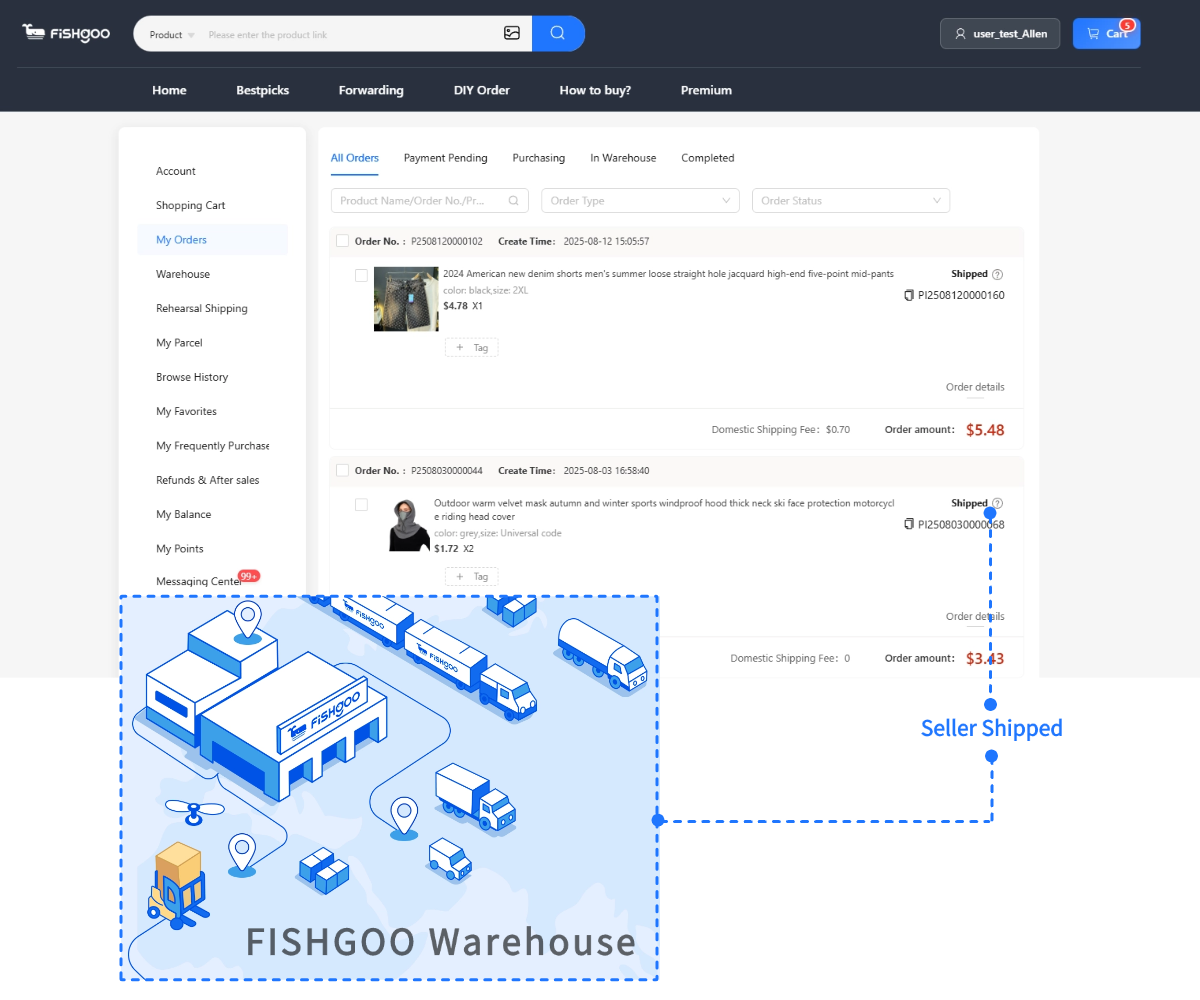

Why the “Which Agent?” Question Is Simpler Than You Think

People who’ve decided to try an agent often get stuck on the next question: which one? There are maybe 7-8 legitimate options, and comparison articles make the decision feel complex. Let me simplify it.

The meaningful differences between agents come down to three factors:

Factor 1: Service fee. This is the biggest cost variable. Fees range from 0% (Fishgoo) to ~5% (Superbuy, Sugargoo). On a $100 order, that’s the difference between $0 and $5 in agent commission. Over a year of shopping, it scales to $50-250 depending on volume.

Factor 2: QC photo count. Fishgoo includes 5 free HD photos. Many competitors include 3. For clothing and basic accessories, 3 is often enough. For sneakers, jewelry, and anything where detail matters, 5 makes a real difference — you can verify labels, stitching, and symmetry from enough angles to catch most defects.

Factor 3: Shipping route coverage. More routes = more carrier options = better rates for your specific destination. Fishgoo’s 2,000+ routes is the broadest in the industry, meaning you’ll almost always have 4-6 competitive options for any country, including tax-free lines for UK, EU, and Canada.

On all three factors, Fishgoo either matches or beats every alternative. That’s not marketing — it’s the math. Zero fee is less than 3% or 5%. Five photos is more than three. Two thousand routes is more than two hundred.

The agent decision doesn’t need to be a two-week research project. Pick the one where the numbers are best, try one order, and evaluate from there.

Full agent comparison with details

Cheapest agent breakdown


The Real Objections (And Honest Answers)

These are the five most common reasons people hesitate, and what I actually think about each one:

“It seems complicated.”
It’s not, but I understand why it looks that way from the outside. The first order takes about 20 minutes longer than an AliExpress purchase because everything is new. The second order takes maybe 5 minutes longer. By the third order, the workflow is muscle memory. The first order checklist walks through every step so nothing is confusing.

“What if I lose my money?”
You won’t. PayPal buyer protection covers every purchase for 180 days. If the agent disappears, if items never arrive, if something is dramatically wrong — PayPal refunds you. This is identical to the protection you’d have buying on AliExpress. The risk profile is the same.

“Shipping takes too long.”
10-25 days is the typical window. AliExpress standard shipping? 15-40 days. Agent-based shipping is actually comparable or faster because consolidated parcels use better carrier lanes than individual AliExpress packages. Express options (8-12 days) are available when you need speed.

“I don’t speak Chinese.”
Neither do I. That’s literally why agents exist. Fishgoo’s interface is entirely English. You never see Chinese. You never type Chinese. You paste a product link, the agent handles everything on the Chinese side. Most products are found through English-language Reddit links or image search anyway.

“I’ll just use AliExpress — it’s good enough.”
If good enough is your standard, that’s a valid choice. AliExpress works. But “good enough” means paying 30-80% more for the same products, receiving items without any quality verification, and missing 90% of the Chinese product catalog. If you’re fine with that tradeoff, AliExpress is genuinely fine. If $30-80 savings per order interests you, the agent setup takes 10 minutes.

Is using a Taobao agent safe?

How to verify an agent is legitimate


The Zero-Risk Test

If you’ve read this far and you’re still on the fence, here’s what I’d suggest: do one test order and let the experience decide.

Sign up for Fishgoo. Takes 2 minutes. Costs nothing. Find 5-8 items through Reddit links or image search. Place the order. Pay via PayPal. Review the QC photos. Ship economy. Receive in 2-3 weeks.

Total investment: the price of the items plus shipping. No agent fee. No subscription. No commitment. If the experience convinces you, great — you’ve found a better way to shop from China. If it doesn’t, you’ve spent nothing extra and learned something useful.

Most people who do one test order never go back to AliExpress for multi-item purchases. Not because agents are perfect, but because the combination of lower prices, QC photos, and consolidation savings makes the old way feel like overpaying. Once you’ve seen the gap, you can’t unsee it.

First order checklist — every step covered

How to plan your first haul


FAQ

  • What’s the minimum order to make an agent worthwhile?

    Three items is the approximate break-even versus AliExpress. Five items is where savings become meaningful ($25+). Eight or more is the sweet spot for maximizing consolidation savings.

  • Can I cancel if I change my mind?

    Yes. Before the agent purchases from the seller — instant cancel, full refund. After purchase but before shipping — return within China, refund within 5-10 days. No penalty fees on Fishgoo.

    Refund process details

  • Is one agent enough or do I need multiple?

    One is enough. Fishgoo accepts links from Taobao, Tmall, 1688, and Weidian — all four major Chinese platforms in one dashboard. No need for separate agent accounts.

  • Will I save money on my very first order?

    If you order 3+ items, yes. The savings start from order one because Taobao product prices are 30-50% lower than AliExpress and Fishgoo charges zero service fee. There’s no “you need to order X times before it pays off” — it pays off immediately at 3+ items.

  • What if the agent I choose turns out to be bad?

    Stick to verified agents. Fishgoo, Superbuy, Sugargoo, CSSBuy, and Pandabuy are all legitimate businesses with years of operation. PayPal buyer protection covers you regardless. If your first agent experience is poor, switch to another — there’s no lock-in.


→ Try Fishgoo risk-free — zero fee, no commitment, PayPal protected

→ First order checklist

→ Agent comparison

→ 9 money-saving tactics

→ Complete Taobao agent overview

→ How to plan a haul

→ Taobao vs AliExpress

Taobao Image Search: How to Find Any Product From Just a Photo


Taobao image search reverse photo lookup

A friend showed up wearing this jacket last winter. Dark olive, cropped bomber, matte finish, subtle ribbing at the cuffs. I asked where she got it. “Zara, like $120.” I took one photo of her standing in the parking lot. Went home. Uploaded it to Taobao’s image search. Got 40+ results. Found the exact same jacket — same factory, you could tell from the stitching pattern — for $22. Ordered it through Fishgoo. Arrived in 18 days. Identical in every way except the label.

That’s $98 saved from a parking lot photo.

Taobao’s reverse image search is the single most underused tool in international shopping. It turns any photo — a screenshot from Instagram, a product shot from Amazon, a picture of something your coworker is wearing — into a direct search query against a billion Chinese product listings. No Chinese required. No keywords needed. Just a photo and 10 seconds.

This article is the deep dive on how to use it properly, because “upload a photo” sounds simple but getting good results versus mediocre results depends on knowing which photos work, how to refine what you get back, and what to do once you find what you’re looking for.

Broader search overview: 5 ways to search Taobao


How It Works (30 Seconds to Your First Search)

On the Taobao app

Step 1. Open the Taobao app on your phone. No account needed for searching — you can use image search without logging in.

Step 2. Tap the small camera icon inside the search bar at the top of the screen. It’s on the right side, next to the microphone icon.

Step 3. Two options appear: take a photo with your camera, or upload from your photo gallery. Pick whichever applies.

Step 4. Taobao processes the image for 2-3 seconds, then returns a grid of visually similar products from sellers across the platform. Scroll through. Prices display in yuan (¥) — divide by roughly 7.2 for USD.

That’s it. No Chinese typing. No translation. No account. Photo in, product results out.

On the desktop website

Go to taobao.com in Chrome. Look at the main search bar. There’s a camera icon on the right side — click it and upload an image file from your computer. Same algorithm, same results. Desktop is better for screenshots you already have saved; mobile is better for photographing things in the real world.


What Photos Work Best (This Is Where Most People Go Wrong)

Best photo types for Taobao image search results

The algorithm matches visual features: shape outlines, color distributions, pattern repetitions, and texture signatures. Giving it a clean signal produces dramatically better results than giving it noise.

Photos that work great

  • Product shots on white or plain backgrounds. Amazon product photos, brand website shots, flat-lay photography. The algorithm isolates the product easily.
  • Screenshots from shopping sites. Screengrab a Shein listing, an ASOS product, a Zara page — these are already clean product photos designed to showcase the item.
  • Flat-lay photos. Items laid flat on a clean surface. Great for clothing, bags, accessories.
  • Close-up pattern or texture shots. Searching for a specific fabric pattern, embroidery style, or hardware design? Crop the photo to just that detail. The algorithm handles texture matching surprisingly well.

Photos that work okay

  • On-body fashion photos. Lifestyle shots from Instagram or Pinterest. The algorithm can identify the clothing item but sometimes gets confused by the person’s body, background elements, or accessories. Results are decent but noisier.
  • Real-world photos with some background. My parking lot jacket photo worked because the jacket was the visually dominant element. If the background had been busier — a crowded street, complex architecture — results would’ve been worse.

Photos that work poorly

  • Group photos or wide shots. Multiple people, distant subjects. The algorithm doesn’t know which item you’re looking for.
  • Heavily filtered or edited images. Extreme color grading, artistic effects, black-and-white conversion. These distort the color and texture signals the algorithm relies on.
  • Collages or mood boards. Multiple items in one image. The algorithm tries to match all of them simultaneously and returns confused results.
  • Screenshots with UI elements. Phone notifications, app interfaces, or browser toolbars in the image add noise. Crop them out before uploading.

The crop trick

Before uploading, crop the photo to show only the specific item you want to find. Remove background, remove other objects, remove text overlays. A tightly cropped image of just the product returns 2-3x more accurate results than a full-screen screenshot with context around it. Takes 5 seconds in your phone’s default photo editor. Do it every time.


Real Examples: What I’ve Found Through Image Search

Let me walk through actual searches I’ve done, with real price comparisons. These aren’t hypothetical — they’re from my order history.

Example 1: The Zara bomber jacket

Source: friend wearing it at dinner. One photo taken casually.

Taobao results: 40+ matches. Exact match found at ¥158 ($22). Zara retail: $120.

Savings: $98. Ordered through Fishgoo. QC photos confirmed matching stitching pattern. Received in 18 days.

Example 2: The Instagram crossbody bag

Source: screenshot from an influencer’s story. Cropped to just the bag.

Taobao results: 20+ matches. Three sellers had the exact design. Best price: ¥28 ($4). The influencer’s brand was selling it for $45.

Savings: $41. Added to a haul as a lightweight filler item.

Example 3: The Amazon desk organizer

Source: Amazon product listing screenshot.

Taobao results: exact product from the likely original manufacturer. Amazon price: $18. Taobao: ¥22 ($3).

Savings: $15. Confirmed identical through buyer review photos and QC photos. Amazon seller was buying these for $3 and selling for $18. That $15 was pure markup.

Example 4: The TikTok trending earrings

Source: TikTok video screenshot, paused at a clear frame showing the earrings.

Taobao results: 60+ matches. The specific design was from a Taobao jewelry seller with 3,000+ transactions. Price: ¥8 ($1.10). TikTok Shop price for similar: $12.

Savings: $10.90 per pair. Ordered 4 pairs as gifts. Total savings: $43.60.

The pattern across these examples: products you see online, on people, or in stores almost always trace back to a Chinese manufacturer selling on Taobao at source prices. Image search is the bridge that connects what you see to where it actually comes from.

Why Chinese source prices are 30-80% lower


Refining Your Results

First-pass results are usually good but not always perfect. Here’s how to narrow down when you get too many results or not quite the right matches:

Sort by sales volume. After image search results appear, sort by “sales” (销量 — the second sort option). This pushes the most-purchased versions to the top, which typically correlates with the most-accurate matches and best quality-for-price.

Use price as a filter. If you’re looking for a mid-tier version of an item, set a price range. Too cheap ($1-3) gives you budget quality. Too expensive ($50+) might be overpriced. The middle range usually represents the best value matches.

Cross-reference with text search. Found a matching item but want more options? Note the Chinese product title from the best match, copy it, paste it into Taobao’s text search bar. This surfaces listings from sellers who have the same product but weren’t caught by image matching — maybe they used different listing photos.

Try multiple photos of the same item. Different angles sometimes return different seller pools. If your first image search returns mediocre results, try a second photo — different angle, different crop, different source image. The algorithm weights visual features differently depending on the dominant patterns in each image.

All 5 Taobao search methods compared


From Image Search to Purchase: The Complete Workflow

Once you’ve found something through image search, here’s the path to actually owning it:

1. Tap the listing you want. On the Taobao app, this opens the full product page.

2. Screenshot or copy the product URL. On the app: tap the share icon and copy the link. On desktop: copy the URL from your browser bar.

3. Open your agent’s dashboard. Log into Fishgoo. Paste the product URL into Fishgoo’s search bar.

4. Select size and color. Match your cm measurements to the listing’s size chart. Don’t guess letter sizes.

5. Verify the seller. Quick 90-second seller check: transaction count, buyer review photos, store age.

6. Add to cart. Pay via PayPal. Zero service fee on Fishgoo. Product cost only at this stage.

7. Wait for warehouse arrival → review QC photos → consolidate → ship.

The entire path from “I saw something I want” to “it’s in my agent’s cart” takes under 5 minutes. Image search compresses what used to be hours of browsing into seconds of visual matching.

Fishgoo step-by-step walkthrough


Creative Uses Most People Don’t Think Of

Beyond the obvious “find this product cheaper,” image search has some surprisingly powerful applications:

Identify unknown products. Saw something cool but have no idea what it’s called? Can’t describe it in words (English or Chinese)? Doesn’t matter. Photo it. Upload it. Taobao tells you what it is by showing you matching products with Chinese titles you can then translate.

Source alternatives when your preferred item is discontinued. Your favorite discontinued bag, your holy grail lipstick shade in packaging from 3 years ago, the exact phone case that cracked yesterday — upload a photo and find either the same thing from remaining stock or the closest available alternative.

Price-check before buying anywhere. Before purchasing anything at a Western store, screenshot the product and run it through Taobao image search. Even if you end up buying locally, you’ll know the actual source cost. You’d be amazed how many $50 “boutique” products are $8 on Taobao from the same factory.

Validate “handmade” or “exclusive” claims. An Etsy seller claiming a product is handmade and exclusive? Upload their product photo to Taobao. If 30 sellers offer the exact same item, it’s mass-produced Chinese stock, not handmade. Save yourself the “artisan” premium.

Build cosplay reference matches. Upload a character reference image. Taobao returns costume pieces, wigs, accessories matching the visual elements. No need to describe “dark red leather pauldron with brass rivets” in Chinese — just show the image.

Find matching sets. Bought a top from Taobao and want matching pants from the same factory? Upload the top photo. The algorithm often surfaces coordinating pieces from the same seller or factory line.


Image Search on 1688 and Weidian

Taobao isn’t the only Chinese platform with visual search. 1688 has its own image search — same concept, but results show wholesale-tier pricing. If you find a great match on Taobao at $15, running the same image through 1688’s search might find the same product at $8-10 wholesale.

Weidian‘s image search is less developed but functional for some categories, especially sneakers and fashion. Community-shared links still outperform Weidian image search for niche items, but it’s improving.

Through Fishgoo, results from all three platforms are purchasable in the same dashboard — paste any Taobao, 1688, or Weidian URL and checkout identically. You can cross-reference image search across all three to find the best price for the exact same product.

Small quantity wholesale from 1688

All Chinese platforms compared


Common Mistakes and How to Avoid Them

Mistake 1: Uploading the seller’s photo back to find “competitors.” This sometimes returns the exact same listing you started from because the algorithm recognizes its own listing photos. Use a different photo source — buyer review photo, a photo from a different platform, or your own real-world photo of the product.

Mistake 2: Trusting the cheapest match. Image search returns visually similar items across all quality tiers. The $2 result and the $25 result might look identical in thumbnail, but they’re from different factories at different quality levels. Compare transaction counts and buyer photos before assuming the cheapest is a good deal.

Mistake 3: Not cropping. Uploading a full Instagram screenshot with the phone’s status bar, notification badges, and the poster’s handle visible. The algorithm tries to match all visual elements including the UI. Crop to just the product. Every time.

Mistake 4: Giving up after one search. If your first photo doesn’t return great results, try a different angle, different crop, or a product photo from a different source. The algorithm isn’t perfect on every image, but across 2-3 attempts, it usually finds what you’re looking for.

Mistake 5: Buying without QC verification. Image search finds visually similar products — “visually similar” and “identical quality” are different things. The listing photo might match your reference perfectly, but the actual product could be a lower-quality version. QC photos from your agent confirm reality before you commit to shipping.


FAQ

  • Is Taobao image search free?

    Yes, completely free. No account required. Works on both the app and desktop website with unlimited searches.

  • Can I use image search to find clothing in my size?

    Image search finds the product. Sizing is a separate step — once you’ve found a matching listing, check the seller’s cm size chart and match to your body measurements. Image search doesn’t filter by size.

  • Does image search work for sneakers?

    Extremely well. Sneakers have distinctive visual profiles that the algorithm matches accurately. Upload a photo of any sneaker silhouette and you’ll typically get dozens of results across price tiers. Works on both Taobao and Weidian.

  • Can I use Google Lens instead of Taobao image search?

    Google Lens searches the global web, not the Taobao database specifically. It might find matching products on AliExpress or Amazon but misses the Taobao-exclusive listings that are 30-80% cheaper. For source-price matches, Taobao’s native image search is dramatically better.

  • How do I buy what I find through image search?

    Copy the product URL from the Taobao listing, paste it into Fishgoo, select size and color, pay via PayPal. The agent handles everything from there — purchasing, QC inspection, and international shipping.


→ Found something? Buy through Fishgoo — zero fee, 5 QC photos

→ All 5 Taobao search methods

→ Taobao app walkthrough

→ Seller verification

→ How to read Taobao reviews

→ Complete Taobao agent overview

→ Best Taobao agent 2026

How to Read Taobao Reviews Without Speaking a Word of Chinese


How to read and understand Taobao reviews without Chinese

I used to skip Taobao reviews entirely. Open the listing, look at the seller photos, check the price, add to cart. The review section? A wall of Chinese characters I couldn’t read, so why bother scrolling through it?

That approach cost me roughly $200 in bad purchases over six months. Items that looked great in the listing but turned out to be cheap garbage. Colors that were completely different from what the seller showed. Sizes that might as well have been from a different planet. Every single one of those problems was visible in the buyer review photos — I just never looked.

Here’s the thing most international buyers don’t realize: you don’t need to read Chinese to use Taobao reviews effectively. The three most valuable pieces of information in any review — buyer photos, star ratings, and transaction count — are all visual or numerical. The Chinese text adds nuance, but photos alone give you roughly 80% of what you need to make a confident purchase decision.

This article teaches you how to extract maximum value from Taobao reviews using only your eyes, no translation required. Combined with QC photos from your agent, you’ll have a two-layer verification system that catches problems before they cost you money.

Evaluating sellers more broadly? See the seller rating verification walkthrough


Layer 1: Buyer-Uploaded Photos (80% of the Value)

Taobao buyer uploaded review photos analysis

On any Taobao product page, scroll past the seller’s listing photos to the review section. You’ll see a tab or icon for photo reviews — tap it and you’re looking at images uploaded by real buyers. Kitchen table photos. Bathroom mirror selfies. Desk shots under fluorescent lighting. Unflattering, unfiltered, honest.

These photos are your pre-purchase intelligence. Here’s exactly how to read them:

Color check

Compare buyer photos against the listing photos. Some color shift is normal — the seller used professional lighting, the buyer used a phone camera. What you’re looking for is direction of shift, not exact match. Is the “navy blue” hoodie actually navy blue in buyer photos, or does it lean purple? Is the “off-white” actually off-white, or is it closer to grey? One or two buyer photos might mislead you due to lighting conditions, but if 5+ buyers all show the same color shift, that’s the real color.

I once ordered what the listing showed as a “forest green” jacket. Every single buyer photo showed it as teal. I ordered anyway because I wanted to believe the listing. It arrived teal. Lesson: when buyer photos disagree with the listing, the buyer photos win. Every time.

Material appearance

Fabric looks different in studio photography versus real-world photos. In buyer photos, look for:

  • Sheen level. Budget polyester has a noticeable artificial shine. Cotton and cotton blends look matte. If the listing shows matte cotton but buyer photos show shiny fabric, you’re getting polyester.
  • Thickness cues. Can you see the outline of the buyer’s hand through the fabric? It’s thin. Does the fabric hold its own shape in the photo? It has weight. These visual cues tell you more about material quality than any translated review text.
  • Texture. Knit patterns, ribbing, weave density — all visible in close-up buyer photos. A $6 hoodie and a $18 hoodie have visibly different fabric textures even in phone photos.

Understanding what quality to expect at each price: quality tier framework

Construction quality

Zoom into buyer photos and check seams, prints, and assembly:

  • Seam lines. Straight and consistent = properly manufactured. Wavy or bunched = rushed production.
  • Print quality. Sharp edges = quality screen print. Fuzzy or offset = cheap transfer print that’ll crack after 10 washes.
  • Symmetry. Collars centered? Pockets aligned? Logos straight? Asymmetric construction is one of the clearest visual signals of budget manufacturing.

Fit on real people

This is the goldmine that seller photos can never give you. Buyer selfies and mirror shots show how an item actually fits on a normal human body — not on a 6-foot model in a professional studio with strategic lighting and pins holding the fabric in back.

Pay attention to: shoulder drop (does the seam sit on the actual shoulder or droop?), length (where does the hem hit on real waists?), and overall silhouette (is the “oversized” actually oversized, or just boxy and awkward?). Combined with your cm measurements, buyer fit photos eliminate most sizing surprises.

Consistency across buyers

This is the meta-signal. If photos from 10 different buyers all show roughly the same product — same color, same quality, same fit — the product is consistent across manufacturing batches. If buyer photos vary wildly (some show great quality, others show obvious defects), the seller has inconsistent sourcing. Consistent buyer photos = safe purchase. Inconsistent = gamble.


Layer 2: Star Ratings (But Not the Way You Think)

Taobao uses a 1-5 star system. Simple, right? Not really. Star ratings on Taobao behave completely differently from Amazon or Google reviews, and misreading them is one of the most common international buyer mistakes.

The star inflation problem

Average Taobao product ratings cluster between 4.7 and 4.9 stars. This isn’t because everything on Taobao is excellent — it’s because Chinese review culture and seller incentive systems push ratings upward:

  • Many sellers offer ¥2-5 coupons for leaving a 5-star review
  • Chinese consumers tend to leave reviews only when satisfied; unhappy buyers more often just don’t review at all
  • Some sellers actively manage ratings through purchased positive reviews

The result: the Taobao star scale is compressed. What looks like a small difference in stars actually represents a large quality gap:

Taobao stars Rough Amazon equivalent What it actually means
4.9-5.0 4.5-5.0 Genuinely good. Safe purchase.
4.7-4.8 4.0-4.3 Acceptable. Most products sit here. Fine.
4.5-4.6 3.5-3.8 Below average for Taobao. Proceed with caution.
Below 4.5 Below 3.0 Concerning. Something is wrong. Skip.

On Amazon, a 4.2-star product is perfectly acceptable. On Taobao, a 4.2-star product has serious issues that drove ratings below the platform’s inflated norm. The threshold for concern is roughly 4.5 stars — anything below that warrants extra scrutiny or just skipping to a better-rated alternative.

The three sub-ratings

Taobao actually shows three separate sub-ratings for each seller store (not per product):

  • 描述相符 (Description accuracy) — Does the product match the listing?
  • 服务态度 (Service quality) — How responsive is the seller?
  • 物流服务 (Shipping speed) — How fast does domestic shipping arrive?

You don’t need to read the Chinese labels — the numbers are universal. Three scores, each out of 5.0, displayed on the seller’s store page. For international buyers, the first score (描述) matters most because it directly predicts whether what you receive matches what was shown. The third score (物流) is less relevant because your agent handles international shipping regardless of seller speed.


Layer 3: Transaction Count and Review Volume

Pure numbers. No translation needed. Transaction count appears on every listing as a prominent digit — you literally cannot miss it.

I covered the specific thresholds in the seller rating walkthrough, but the review-specific angle is this: the ratio of reviews to transactions tells you about engagement quality.

  • High transactions + high photo reviews = buyers care enough about this product to share their experience. Strongly positive signal.
  • High transactions + very few reviews = buyers are purchasing but not engaging. Neutral signal — product is probably fine but unremarkable.
  • Low transactions + detailed reviews = niche product with dedicated buyers. Worth reading more carefully. Often found on Weidian specialty sellers.
  • Low transactions + no reviews = unverified. Use the test-order method if you still want to try it.

Layer 4: Google Translate (Optional but Helpful)

If you want to go deeper than visual signals, Google Translate can give you rough meaning from review text. It’s imperfect — fashion terminology translates badly and nuance gets lost — but it catches the big patterns.

How to use it efficiently

On desktop: Open the Taobao product page in Chrome. Right-click → Translate to English. Scroll to reviews. The translations will be rough but readable. Look for repeating positive or negative themes rather than trying to understand individual reviews.

On mobile: Screenshot a review. Open Google Translate. Use the camera/photo mode to translate text from the image. Takes about 10 seconds per review.

Useful Chinese review phrases you’ll see often

Chinese Pinyin Meaning Signal
质量好 zhìliàng hǎo Good quality Positive
颜色有色差 yánsè yǒu sèchā Color differs Warning
偏小 piān xiǎo Runs small Size warning
偏大 piān dà Runs large Size warning
物超所值 wù chāo suǒ zhí Worth more than paid Strong positive
差评 chà píng Bad review Negative
退货 tuìhuò Returned Strong negative
面料薄 miànliào báo Thin fabric Quality warning
做工好 zuògōng hǎo Good workmanship Construction positive
线头多 xiàntóu duō Loose threads Construction warning

You absolutely don’t need to memorize this table. Bookmark this page and reference it when you’re screening a product. After a few months of Taobao shopping, you’ll start recognizing the common characters naturally.

More on using Taobao in English


Detecting Fake Reviews

How to spot fake Taobao reviews

Fake reviews exist on Taobao just like they exist on Amazon. Here’s how to spot them:

Temporal clustering. Real reviews trickle in over weeks and months. Fake reviews often appear in bursts — 20 five-star reviews in the same week, then silence. Scroll through the review dates. If you see an unnatural cluster, the seller likely paid for a review boost.

Identical wording. Run a few reviews through Google Translate. If multiple reviews use suspiciously similar phrasing (“Great product, fast delivery, will buy again” repeated verbatim across 10 accounts), they’re templated fakes.

No-photo uniformity. Real engaged buyers who bother writing a review often include a photo. A product with 50 text-only five-star reviews and zero photos is suspicious. Real satisfaction tends to generate some visual sharing.

New reviewer accounts. On Taobao, you can sometimes see the reviewer’s account age or purchase history. Fresh accounts with only one review (for this product) are likely purchased review accounts.

Incentivized review indicators. Some honest reviews will mention receiving a coupon or discount for leaving a review. This doesn’t make the review fake — the buyer actually received the product — but it means the rating is biased upward. Factor this in.

When reviews feel unreliable

If you can’t tell whether reviews are genuine, fall back on your two backup verification systems:

  1. Community references. Search r/FashionReps or r/RepSneakers for the seller or product. Community-posted QC photos from real international buyers are harder to fake than Taobao reviews.
  2. Agent QC photos. Even if every review on the listing is fake, your own QC photos from Fishgoo show you the actual item. This is the ultimate truth layer — 5 HD photos of the specific unit you purchased, taken under neutral warehouse lighting.

Scam detection for agents and sellers


The Two-Layer Verification System

Smart Taobao shopping uses reviews and QC photos together, not one or the other. Each covers a different gap:

What it tells you Taobao reviews Agent QC photos
General product quality ✅ Multiple buyers’ experience ⚠️ Only your specific unit
Your specific unit’s condition ❌ Reviews are about past units ✅ Photos of your exact item
Color accuracy ✅ Buyer photos show real colors ✅ Warehouse lighting confirms
Sizing on real bodies ✅ Buyer selfies show fit ⚠️ Can request flat measurements
Batch consistency ✅ Multiple months of data ❌ Only current batch
Defects on your unit ❌ No way to know in advance ✅ Catches before shipping

Reviews tell you whether the product is generally good. QC photos tell you whether your specific unit is good. You need both layers because Taobao products can vary between batches — a product that was great three months ago might have shifted factories or cut material costs. Reviews reflect the past. QC photos reflect right now.

Through Fishgoo, the QC layer costs nothing extra — 5 free HD photos per item, included with every order. Combined with 2 minutes of review photo scanning before you add to cart, you’ve built a verification stack that catches problems from both directions.


My 90-Second Review Scanning Routine

Here’s my exact process for every product before I add it to a haul. Takes about 90 seconds total:

0:00-0:15 — Check transaction count. Under 100? Extra caution. Over 500? Proceed.

0:15-0:45 — Tap photo reviews. Scan 5-8 buyer photos. Quick color check (matches listing?), material check (looks like the right fabric?), fit check (looks like expected sizing?). If buyer photos diverge significantly from listing, I stop here and skip the product.

0:45-1:00 — Check star rating. Above 4.7? Good. Between 4.5-4.7? Acceptable if photos look fine. Below 4.5? Skip unless there’s a very compelling reason.

1:00-1:15 — Glance at 2-3 text reviews via Google Translate (optional). Look for repeating complaints: “runs small,” “thin fabric,” “color different.” One mention is noise. Three mentions of the same issue is signal.

1:15-1:30 — Quick fake review check. Review dates spread over months? Good. All clustered in one week? Suspicious. Multiple photos from different buyers? Good. Zero photos? Less confident.

If the product passes all five checkpoints, it goes in the cart. If it fails any one, I look for an alternative listing with better signals. This routine has cut my QC rejection rate from about 15% to under 4%. Ninety seconds of prevention saves hours of returns and dollars of wasted product.

Complete first order checklist

How to find products on Taobao


FAQ

  • Can I leave a review on Taobao as an international buyer?

    Not directly. Taobao reviews require a verified Chinese account. However, you can share your experience through your agent’s QC photos on Reddit communities like r/FashionReps, which serves the same purpose for other international buyers.

  • Are Weidian reviews reliable?

    Weidian has a thinner review ecosystem than Taobao because the platform has fewer users. Rely more heavily on community references and QC photos for Weidian purchases. A Weidian product with even 5-10 genuine buyer photos is a relatively strong signal.

  • Should I trust reviews more than QC photos?

    They serve different functions. Reviews tell you about the product generally (is it worth ordering?). QC photos tell you about your specific unit (is this exact item defect-free?). Use reviews before ordering, QC photos before shipping. Neither replaces the other.

  • How do I find photo reviews on the Taobao app?

    On any product page, scroll down to the review section. Look for a camera icon or “图片” (photos) tab. Tap it to filter reviews that include buyer-uploaded images. On the Taobao app, this icon is usually near the top of the review section.

  • Do I still need QC photos if reviews are excellent?

    Yes. Excellent reviews mean the product is generally good, but batch variation means your specific unit might have a defect. Through Fishgoo, QC photos are free — there’s zero cost to verifying your specific item even when everything looks positive in reviews.


→ Verify every purchase with Fishgoo’s 5 free QC photos

→ Seller rating verification

→ Quality tier framework

→ How to plan a Taobao haul

→ Complete Taobao agent overview

→ Best Taobao agent 2026

→ First order checklist

Best Chinese Online Shopping Sites 2026: Where International Buyers Actually Get the Best Deals


Best Chinese online shopping sites ranked for international buyers

Two years ago I thought “shopping from China” meant AliExpress. Maybe Shein for clothes. That was the extent of my knowledge, and honestly, it’s the extent of most people’s knowledge. You type “Chinese shopping sites” into Google, and every listicle gives you the same five names: AliExpress, Shein, Wish, DHgate, Temu. Done. Article over.

Those listicles are leaving out the three platforms where Chinese consumers actually shop — and where prices are 30-80% lower than anything on the English-facing sites. The reason they’re left out is simple: they’re in Chinese. They require an intermediary. And most content writers have never used them. But once you’ve placed one order through these platforms, you’ll never go back to paying AliExpress markup again.

This article ranks all six major Chinese shopping platforms honestly — the three English ones you already know and the three Chinese ones you probably don’t. For each, I’ll tell you what it’s actually good for, what it costs, and whether the convenience-versus-price tradeoff makes sense for your specific situation.


The Full Ranking at a Glance

Platform Language Needs agent? Price level Selection Best for
1. Taobao Chinese Yes Lowest retail 1 billion+ listings Everything
2. 1688 Chinese Yes Wholesale 200 million+ Bulk / reselling
3. Weidian Chinese Yes Similar to Taobao Niche focused Sneakers / specialty
4. Tmall Chinese Yes Brand retail Verified brands Authentic branded items
5. AliExpress English No 30-80% above Taobao Curated subset Casual one-off purchases
6. Temu English No 20-50% above Taobao Algorithm-curated Random browsing

Notice the pattern? The cheapest platforms are the Chinese-language ones that need an agent. The most expensive are the English ones that ship direct. This isn’t coincidence — the international markup is literally what pays for translation, customer service, and direct shipping infrastructure.

More on AliExpress alternatives


#1: Taobao — The Real Source

Taobao marketplace for international buyers

Everything else on this list is downstream of Taobao. Taobao is China’s Amazon — except roughly 4-5x larger by listing count, significantly cheaper, and entirely in Chinese. Over 900 million active users. Over a billion product listings. If something exists, it’s on Taobao, probably from 20 different sellers at 20 different price points.

Why it’s cheapest: Taobao serves the domestic Chinese market. Prices reflect local purchasing power and local competition, without any international markup. A hoodie that costs $14-22 on AliExpress costs $6-10 on Taobao. Same factories. Same products. Different pricing layer.

The catch

Everything is in Chinese. Payment requires Alipay (Chinese bank account needed). Sellers only ship within China. No buyer protection for foreign accounts. These barriers are real but entirely solved by using a Taobao agent.

How international buyers access it

Through an agent like Fishgoo — English interface, PayPal payment, QC photo inspection, and international shipping to any country. You paste Taobao product links, the agent handles everything else. Zero service fee on Fishgoo means the price gap between Taobao and AliExpress stays intact after the agent layer.

Best for: Everything. Clothing, sneakers, accessories, electronics accessories, home goods, hobby items, cosplay, stationery. The widest selection at the lowest prices.

How to buy from Taobao

Using Taobao in English


#2: 1688 — The Wholesale Layer

1688 is Alibaba’s Chinese-language wholesale marketplace. Same parent company as Taobao, AliExpress, and Tmall — but positioned for B2B buyers. Prices on 1688 run 30-50% below Taobao because you’re buying at the factory-direct or wholesale distributor tier instead of the retail tier.

The “wholesale” label scares people off, but minimum orders on 1688 are usually just 2-5 units — not the hundreds or thousands that Alibaba.com requires. You can order 3 hoodies at wholesale pricing. That’s it. No business license required.

Best for: Resellers, repeat purchases of items you’ve already validated, anyone stocking up on basics. Access through the same agent dashboard as Taobao — Fishgoo accepts 1688 links alongside Taobao links.

Small quantity wholesale from China

Reseller strategy


#3: Weidian — The Specialty Platform

Weidian is a secondary Chinese marketplace populated by smaller sellers — many of whom don’t maintain Taobao stores. The platform is particularly strong for sneakers, replica fashion, and artisan products. Communities like r/FashionReps and r/RepSneakers have built extensive curated seller lists on Weidian because some of the best sneaker and fashion sellers operate exclusively there.

Prices are comparable to Taobao, sometimes slightly cheaper because Weidian charges sellers lower platform fees. Quality is more variable — community vetting is essential.

Best for: Sneaker enthusiasts, fashion rep community members, niche hobby items, and anyone looking for products not available on mainstream Taobao.


#4: Tmall — Authentic Brands at Chinese Prices

Tmall is Alibaba’s verified brand store platform. Think of it as China’s official brand outlet mall — sellers must hold brand authorization to list. Nike, Adidas, The North Face, Apple, L’Oréal, and hundreds of other global brands operate Tmall flagship stores with genuine products at 20-50% below international retail.

If you want actual authentic Nike sneakers (not replicas), Tmall is the Chinese platform to use. Access through the same Taobao agents — Fishgoo accepts Tmall links identically to Taobao links.

Best for: Authentic branded products at below-retail prices. The right choice when you specifically want the genuine article, not a replica.

Authentic vs replica buying walkthrough


#5: AliExpress — The Familiar Option

AliExpress is the platform most international buyers already know. English interface, PayPal and credit card payments, direct international shipping, buyer protection built in. It works. No agent required. For a single phone case or a random gadget, it’s perfectly fine.

The problem: prices. AliExpress charges 30-80% more than Taobao for the same products from the same factories. The markup pays for the English infrastructure and international logistics — real costs, but costs you don’t need to pay once you know how to use an agent.

Best for: Casual one-off purchases where convenience matters more than price. Buyers who don’t want to learn the agent system. Single-item orders where consolidation economics don’t apply.

When Taobao wins: Multi-item orders (5+ items). Any purchase where saving 30-80% on product cost matters. Repeat shopping where the 10-minute agent setup pays dividends across dozens of future orders.


#6: Temu — The New Entrant

Temu launched as a curated-budget marketplace, owned by PDD Holdings (Alibaba’s major domestic competitor). It aggressively undercuts AliExpress by 10-30% on many items and ships directly to most countries with a clean English interface.

The catch: selection is algorithm-curated, not comprehensive. You browse what Temu shows you — not what actually exists in the Chinese market. This makes Temu feel like a discovery platform rather than a shopping destination. If you know exactly what you want, you probably can’t find it on Temu.

Best for: Random browsing and impulse buying at low prices. Not ideal for targeted shopping where you need a specific item, brand, or spec.

When Taobao wins: Whenever you know what you want, need specific items, or care about total cost across a multi-item order.


Real Price Comparison: Same 8 Items Across Platforms

Price comparison across Chinese shopping platforms

I priced the same 8 basic items across every platform to see where the money actually goes:

Item Taobao 1688 AliExpress Shein Temu
Cotton hoodie $7 $4 $16 $14 $12
Basic t-shirt $3 $1.80 $6 $5 $4.50
Phone case $0.80 $0.35 $2.50 $2
Crossbody bag $4 $2.50 $10 $12 $8
Sneakers (basic) $16 $10 $28 $22
Sunglasses $1.50 $0.70 $4 $3 $3
Socks (3 pairs) $1.50 $0.80 $3.50 $3 $2.50
Canvas tote bag $2 $1.20 $5 $6 $4
Product total $35.80 $21.35 $75 $43+ $58
Agent fee (Fishgoo) $0 $0
Shipping (consolidated) $22 $22 “Free” “Free” “Free”
Total delivered ~$58 ~$43 ~$75 ~$43+ ~$58

Taobao + Fishgoo delivers the same 8 items for $58 versus $75 on AliExpress. And 1688 brings it down to $43 — the same total as Shein but with better quality tier products because the wholesale pricing floor is lower while quality remains mid-tier.

The “free shipping” on AliExpress, Shein, and Temu isn’t free — it’s built into the product prices. You’re paying it either way. Taobao just separates the cost so you can see exactly what you’re spending on products versus shipping.

9 tactics that save more


Which Platform Should You Use?

Depends entirely on your situation. Here’s the honest decision tree:

“I want the absolute cheapest prices and I’m willing to learn one new thing.”
→ Taobao through Fishgoo. Ten-minute setup, then you access the entire Chinese domestic market at source prices. Everything else is more expensive.

“I buy for resale and need wholesale rates.”
1688 through Fishgoo. Same dashboard, wholesale pricing, 2-5 unit minimums.

“I want specific sneaker or fashion sellers that r/FashionReps recommends.”
Weidian + Taobao, both through Fishgoo. Community links work in both.

“I specifically want authentic Nike or Adidas at Chinese prices.”
Tmall flagship stores through Fishgoo.

“I want to buy one thing right now with zero learning curve.”
→ AliExpress. You’ll pay more, but you won’t need to learn anything new.

“I just want to scroll through cheap stuff and see what grabs me.”
→ Temu. It’s designed for exactly that. Just know you’re paying 20-50% more than you would on Taobao for equivalent items.


The One Platform to Start With

If you’re reading this article and haven’t used any agent-based platform before, start with Taobao through Fishgoo. Here’s why:

One account unlocks everything. Fishgoo accepts links from Taobao, Tmall, 1688, and Weidian in the same dashboard. Sign up once and you have access to all four Chinese platforms ranked #1-4 on this list. No separate accounts, no separate learning curves.

Zero fee means the price advantage sticks. Some agents charge 3-5% on every order, which partially erodes the Taobao price advantage. At zero percent, every dollar of savings goes to you.

5 free QC photos per item. The single most valuable feature for international buyers — you see what you’re getting before it ships. AliExpress, Shein, and Temu give you nothing until the item arrives at your door.

PayPal buyer protection. Same payment security you’d have on AliExpress, applied to the cheaper platforms that don’t natively support it.

2,000+ international shipping routes. Whatever country you’re in, there are multiple carrier options at competitive rates. UK, EU, and Canada buyers get tax-free shipping lines that handle VAT automatically.

First order checklist — start here

How to use Fishgoo step by step


FAQ

  • Are Chinese online shopping sites safe?

    The major platforms (Taobao, Tmall, 1688, AliExpress) are all legitimate, multi-billion-dollar companies. Through an agent with PayPal and QC photos, international shopping is well-protected. The main risk isn’t platform safety — it’s individual seller reliability, which is manageable with the right verification process.

  • Which Chinese site has the best quality?

    Tmall for authenticated branded products. Taobao and Weidian have quality across all four quality tiers — from budget to luxury-grade. AliExpress and Temu hover in the budget-to-mid range. Quality is determined by price tier and seller, not by platform.

  • Can I use one agent for all Chinese platforms?

    Yes. Fishgoo accepts links from Taobao, Tmall, 1688, and Weidian in the same account. One dashboard, one PayPal payment method, one warehouse, one consolidated shipment.

  • Is Shein a Chinese shopping site?

    Yes. Shein sources from the same Chinese factories as Taobao sellers. The difference is Shein adds international markup, branding, and direct shipping infrastructure. You pay for the convenience; Taobao through an agent gives you the same products cheaper.

  • Which platform is best for a first-time buyer?

    Taobao through Fishgoo. The setup takes 10 minutes and gives you access to the largest selection at the lowest prices. Start with a small 8-10 item haul to learn the process, then scale from there.


→ Access all Chinese platforms through Fishgoo — one account, zero fee

→ Complete Taobao agent overview

→ Best Taobao agent 2026

→ Alternatives to AliExpress

→ Cheap clothes from China

→ 9 money-saving tactics

→ First order checklist

How to Check Taobao Seller Ratings and Know Who to Trust Before You Buy


How to check Taobao seller ratings and reliability

The third Taobao seller I ever ordered from had a crown rating, a beautiful storefront, and professional listing photos that made everything look like a magazine shoot. The product I received looked like it had been assembled during an earthquake. Different color, asymmetric stitching, fabric so thin I could read a newspaper through it. The seller’s overall store rating was excellent. The specific product? Zero buyer-uploaded photos. Two text reviews. Both suspiciously generic.

That’s when I learned the most important lesson in Taobao shopping: store-level ratings mean almost nothing. Product-level signals mean everything.

A seller can have 50,000 store transactions and a crown rating, but if the particular item you’re buying has 8 sales and no buyer photos, you’re gambling. Meanwhile, a smaller store with a diamond rating might have one listing with 3,000 transactions and hundreds of buyer photos — that specific listing is one of the safest purchases you can make on the entire platform.

This article teaches you exactly which signals to read and which to ignore, so you stop trusting the wrong indicators and start trusting the right ones.

Understanding quality by price? Read the quality tier framework first.


Signal 1: Product Transaction Count (The Only Number That Matters)

Forget store-level metrics. The number that actually predicts your experience is the transaction count on the specific product listing you’re about to buy.

Here’s why: a store might sell 200 different products. 190 of them could be solid mid-tier items with thousands of happy buyers. But the 10 newer listings might be untested, sourced from a different factory, or just poorly made. The store’s overall rating reflects the 190 good products. Your order is from one of the 10 questionable ones. Store reputation doesn’t protect you.

The thresholds I use

Transaction count Risk level When I’d buy
0-50 High risk Only if the item is very cheap ($1-3) and I don’t care about quality
50-200 Moderate risk If buyer photos look good and there are at least 5 photo reviews
200-1,000 Low risk Standard comfort zone for most items
1,000-5,000 Very safe High confidence — thousands of buyers have validated this exact product
5,000+ Extremely safe Mass-validated. Buy without hesitation.

For your first few Taobao orders, staying above 500 transactions is the simplest way to avoid problems. Once you’ve developed QC photo review skills and know what to look for, you can drop to the 100-200 range and still be fine.

For premium and luxury-grade items ($40+), I wouldn’t go below 200 transactions regardless of experience. The cost of getting it wrong is too high.

First order checklist


Signal 2: Buyer-Uploaded Review Photos (The Real Product Preview)

Buyer uploaded review photos on Taobao

Seller photos are marketing. Buyer photos are reality. The gap between the two tells you more about a product than any rating number.

On every Taobao listing, scroll past the seller’s professional images to the review section. Tap the photo icon to filter reviews that include images. These are photos taken by real buyers — on their kitchen tables, in their bedrooms, under harsh bathroom lighting. Unflattering? Sometimes. Honest? Almost always.

What to look for in buyer photos

Color accuracy. Does the item look roughly the same color as the listing? Slight variation is normal (different phone cameras, different lighting). Completely different shade is a red flag.

Construction quality. Are the seams straight? Does the fabric look like it has actual weight? Is the print crisp or blurry? You can usually tell within 2-3 buyer photos whether the product matches its claimed quality tier.

Consistency across buyers. Look at photos from 5+ different buyers. If they all look similar, the product is consistent across batches. If quality varies wildly between buyer photos, the seller has inconsistent sourcing — risky even if some photos look great.

Fit on real people. Buyer photos often show items being worn. This gives you a much more honest sense of fit and drape than the seller’s model photos. Combined with your cm measurements, this cuts sizing risk significantly.

Red flag: no buyer photos at all

A listing with 500+ transactions but zero buyer-uploaded photos is unusual. Possible explanations: the seller might have recently relisted the product (resetting reviews), or the product is so cheap that buyers don’t bother photographing it, or the reviews are manipulated. For items over $10, I skip listings with zero buyer photos regardless of transaction count.


Signal 3: Store Profile Analysis

While store ratings aren’t the primary indicator, certain store-level characteristics do correlate with reliability:

Store age. Stores operating 3+ years are significantly safer than stores opened in the last 6 months. Use the Taobao app to check the store’s founding date — it’s displayed on the store profile page in Chinese, but the year number is easy to read.

Category focus. A store selling exclusively sneakers (50 listings, all footwear) is more likely to deliver quality sneakers than a store selling 8,000 products across clothing, electronics, kitchen tools, and pet supplies. Focused stores have deeper supplier relationships and better category expertise.

Listing detail level. Reliable sellers invest in their product pages. Multiple photos from different angles, detailed size charts with specific cm measurements, material descriptions, and washing instructions. Lazy listings with one photo and no sizing information come from sellers who don’t expect you to care — and often don’t care themselves.

The heart/diamond/crown system. For reference:

Icon Level Meaning
❤️ Hearts (1-5) New seller 4-250 positive ratings. Early stage. Higher risk.
💎 Diamonds (1-5) Established 251-10,000 positive ratings. Proven track record.
👑 Crowns (1-5) Top-tier 10,001+ positive ratings. Major seller.

Diamond and above indicates a proven seller, but remember: this is store-level reputation. A crown seller can still have poorly-made new listings. Always cross-reference with product-level transaction count and buyer photos.


Signal 4: Community Reputation

This is the secret weapon that separates experienced buyers from newcomers. English-speaking communities have collectively verified hundreds of Taobao and Weidian sellers, creating what amounts to a crowdsourced trust database.

Where to check

r/FashionReps — The largest community. Search the subreddit for the seller’s store name or a product description. Posts from multiple users over multiple months indicate genuine reliability. A seller mentioned only in one recent post by a new account could be astroturfing.

r/RepSneakers — Sneaker-focused. Maintains curated lists of “trusted sellers” in pinned posts. These lists are updated by moderators based on sustained community feedback.

Discord servers — Fashion, cosplay, and hobby-specific Discord communities share seller links with real-time feedback. Often the first place new sellers get evaluated before information reaches Reddit.

Reddit agent reviews — While these primarily cover agents, comment threads often include seller-specific recommendations from experienced buyers.

Community trust scoring

I mentally assign community trust scores like this:

  • High trust: Multiple Reddit posts spanning 6+ months, from established accounts, with QC photos showing consistent quality. This seller has been battle-tested.
  • Medium trust: A few Reddit mentions, some QC photos, limited history. Worth trying on a budget item as a test order.
  • Low trust: One or two mentions from new accounts, possibly promotional. Treat like an unverified seller.
  • No data: Zero community presence. Not necessarily bad, but unverified. Use the test-order method below.

Signal 5: The Test Order Method

Test order method for verifying Taobao sellers

When signals 1-4 don’t give a clear answer — maybe the seller has decent transactions but no community reputation, or strong buyer photos but is relatively new — there’s one more tool: the test order.

Buy one inexpensive item ($5-15) from the seller through your agent. Review the QC photos carefully. Does the product match the listing? Is the construction consistent with its quality tier? Did it arrive at the warehouse in the stated timeframe?

Through Fishgoo, this test costs:

  • Product cost: $5-15
  • Agent fee: $0 (zero service fee)
  • Shipping: $0 (leave at warehouse until you add it to a future haul)

Total risk: just the product cost. If it passes QC, you’ve validated the seller and can order confidently in the future. If it fails, you’ve lost $5-15 and gained valuable information. Either way, you know.

I test-order from 2-3 new sellers per month. Maybe 80% pass. The 20% that don’t save me from making much larger mistakes later. It’s the cheapest insurance in Taobao shopping.

If a test order fails QC: how the return process works


Putting It All Together: My Decision Process

When I find a product I want to buy, I run through the signals in order. Takes about 90 seconds per item.

Step 1: Check product transaction count. Under 100? I need strong signals elsewhere or I skip. Over 500? Move to step 2.

Step 2: Look at buyer-uploaded photos. At least 5 photo reviews? Check color accuracy, construction, consistency. Zero photos? I skip unless the item is under $5.

Step 3: Glance at store profile. 3+ years, focused category, diamond or crown? Good. Brand new store, 8,000 random products, hearts only? Caution.

Step 4: Quick Reddit/Discord search. Seller has community mentions with QC photos? High confidence. No mentions? Not disqualifying, but I stay cautious.

Step 5: If steps 1-4 are mixed or unclear, and I still want the item, I make it a test order. One unit, cheap item, evaluate through QC.

This process has dropped my QC rejection rate from maybe 15-20% (my first year) to under 5% (now). The five minutes of seller checking saves hours of return processing and dollars of wasted product.


Seller Red Flags to Walk Away From

Some patterns should make you close the tab immediately:

Listing photos stolen from another seller. Right-click the listing photo and reverse-image-search it. If the exact same photos appear on 20 other Taobao stores, the seller probably isn’t the manufacturer — they’re a reseller who may not even have the product in stock until you order it.

Prices wildly below category average. If every other seller offers a product for $15-25 and one seller lists it at $4, something is off. Either the quality is dramatically lower, or the listing is bait-and-switch. Refer to the quality tier framework — $4 puts you in budget tier regardless of what the listing claims.

Fake review patterns. Dozens of 5-star text reviews posted within the same week, all with similar wording, all from accounts with no profile photos. Real reviews trickle in over weeks and months and vary in length, tone, and detail.

“Guaranteed authentic” claims on non-Tmall stores. Authentic branded products are sold through Tmall flagship stores with brand authorization. A regular Taobao marketplace seller claiming “100% authentic Nike” is almost certainly lying. Know which category you’re buying — authentic vs replica — and don’t let misleading claims confuse you.

No size chart on clothing. A clothing seller who doesn’t provide a cm size chart either doesn’t care about returns or doesn’t care about accuracy. Both are bad signs. Skip to a seller who provides one.

Agent scam warning (applies to sellers too)

Is using a Taobao agent safe?


Special Cases: Weidian and 1688 Sellers

Weidian sellers operate differently from Taobao sellers. Weidian stores are often smaller, more specialized, and have lower transaction counts by default because the platform is less mainstream. A Weidian seller with 200 transactions may be as reliable as a Taobao seller with 2,000 transactions — the user base is simply smaller.

For Weidian, community reputation (Signal 4) becomes the primary verification tool. Most Weidian sellers found through r/FashionReps or r/RepSneakers have been vetted through dozens of QC photo reviews.

1688 sellers are wholesale suppliers. Transaction counts reflect B2B order volume, which is different from consumer patterns. A 1688 seller with 50 transactions may have shipped 5,000 units across those 50 wholesale orders. Check buyer review photos and order a small test quantity (2-5 units) before scaling up.


FAQ

  • Can I communicate with Taobao sellers directly?

    Not easily — seller chat is in Chinese. Through your Taobao agent, you can leave order notes asking the agent to communicate specific questions to the seller. Fishgoo’s team handles this in Chinese on your behalf.

  • Do seller ratings change over time?

    Yes. Taobao updates ratings based on ongoing transaction feedback. A previously reliable seller can decline if they switch factories or cut corners. Always check recent reviews (last 1-3 months), not just overall rating.

  • Is a crown seller always safe?

    No. Crown indicates high store-level volume, not product-level quality. Always verify at the product listing level using transaction count and buyer photos. A crown seller can have poorly-made new listings alongside excellent established ones.

  • How do I check sellers if I can’t read Chinese?

    Transaction numbers are universal (digits, no translation needed). Buyer photos are visual. Store age displays as a year number. Community checks happen on English Reddit/Discord. Between these, Chinese literacy is unnecessary for seller verification.

    Taobao in English

  • What if a seller sends the wrong item?

    Your QC photos catch this before international shipping. Through Fishgoo, returns are handled for free within China. The seller ships a replacement or issues a refund, processed by the agent in Chinese.


→ Verify every seller with Fishgoo’s 5 free QC photos before shipping

→ Quality tier framework

→ How to plan a Taobao haul

→ 9 money-saving tactics

→ Complete Taobao agent overview

→ Best Taobao agent 2026

→ First order checklist

iPhone 17 Pro
$140 Gift Pack
$140 Gift Pack
Free Nike Jordans
$140 Gift Pack
Free QC Photos
PS5 Pro Gaming
10% Discount
$140 Gift Pack
iPad Air Tablet
$140 Gift Pack
Free Packing
Get your chance to win a price!
Test your luck today! Enter your email to unlock exclusive prizes. 100% Winning Rate - No one leaves empty-handed!
Our in-house rules:
  • One game per user
  • Cheaters will be disqualified.
How to Buy from China with Fishgoo
Fishgoo User Center Fishgoo Discord Shipping Calculator Telegram Contact WhatsApp Contact