Taobao Agent Hidden Costs: Every Fee Explained, Including the Ones Nobody Talks About
When I switched from Superbuy to Fishgoo last year, I expected to save money on service fees. Zero percent versus five percent — obvious win. What I didn’t expect was that service fees were only one of four cost layers I’d been paying. Two of the other layers were visible if you looked carefully. One was almost invisible.
Quick answer
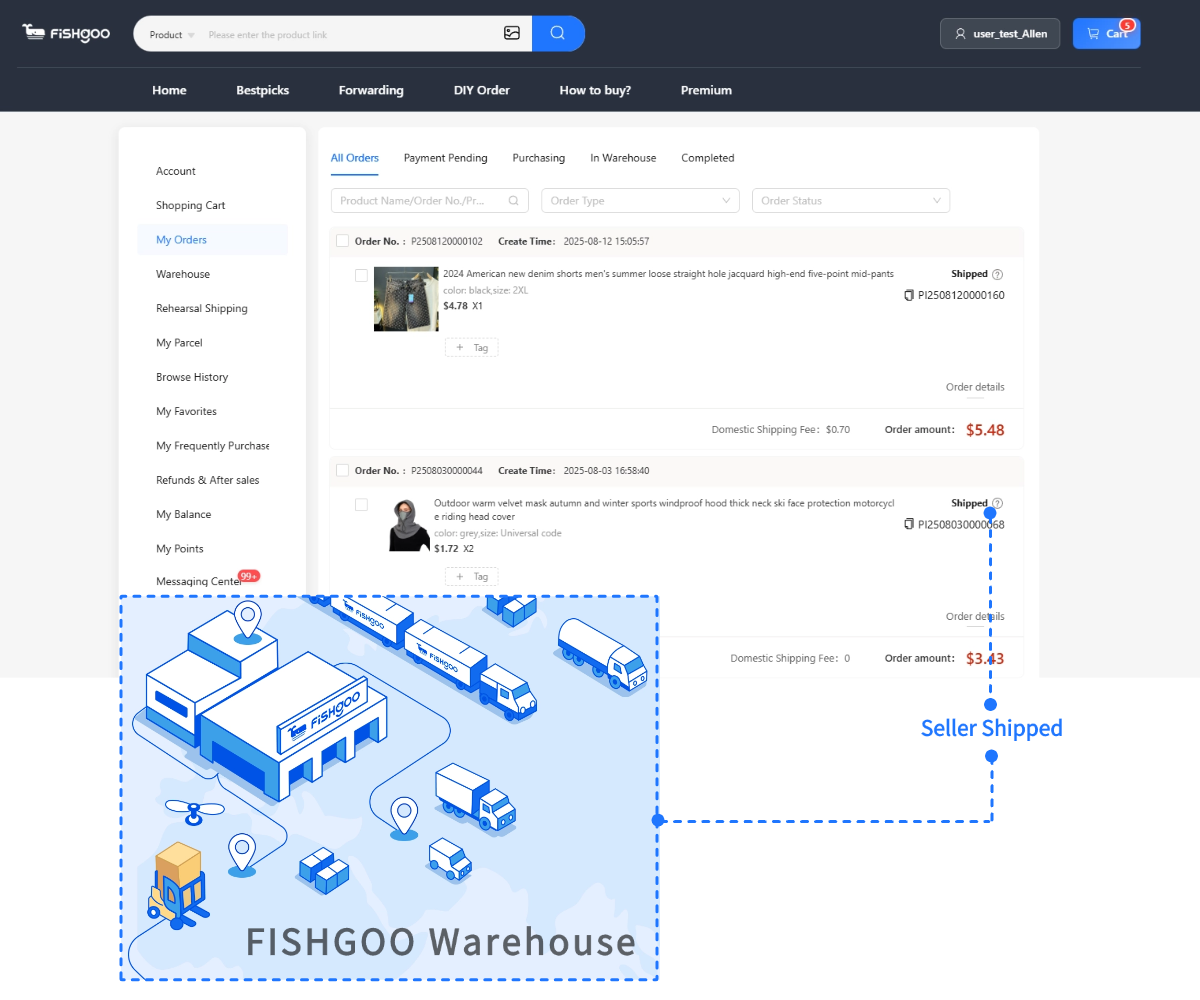
The total cost of buying from China through an agent is: item price + domestic shipping inside China + any service fee + international shipping + payment or currency costs + import duty and VAT in your country. Fishgoo’s purchasing service fee is 0%, so the variables to compare are shipping and the import rules where you live. In 2026 the EU charges a flat €3 per product category on parcels up to €150, and the US has suspended duty-free de minimis.
That invisible layer — exchange rate markup — was quietly adding 3-4% to every order I placed. Not on any invoice. Not in any fee disclosure. Just baked into the currency conversion so that ¥100 worth of products cost me $14.30 instead of the $13.89 I’d pay at the actual interbank rate. On my $2,400 annual spend, that invisible markup was costing me roughly $70-95 per year. On top of the $120 in explicit service fees I was already annoyed about.
This article peels apart every cost layer in agent-based Taobao shopping. Not to scare you — the total cost is still dramatically lower than buying from AliExpress or local retail. But you deserve to know exactly where every dollar goes so you can make informed decisions instead of trusting marketing claims.
The Four Cost Layers
Every Taobao agent order involves four cost components. Two are obvious. Two are quiet. All four contribute to your total cost of ownership.
| Cost layer | Visibility | Range | Who controls it |
|---|---|---|---|
| 1. Product price | Fully visible | Set by Taobao seller | You (by choosing seller/product) |
| 2. Service fee | Fully visible | 0-5% of product cost | Agent |
| 3. International shipping | Visible but complex | $14-65 per parcel | Agent + carrier + you (by choosing method) |
| 4. Exchange rate margin | Mostly invisible | 1-5% above interbank rate | Agent |
Let me break each one down with real numbers.
Layer 1: Product Price — The Same Everywhere (Mostly)
The actual price of the item on Taobao or 1688. This is set by the Chinese seller, not your agent. It should be identical regardless of which agent you use — they’re all buying from the same listing.
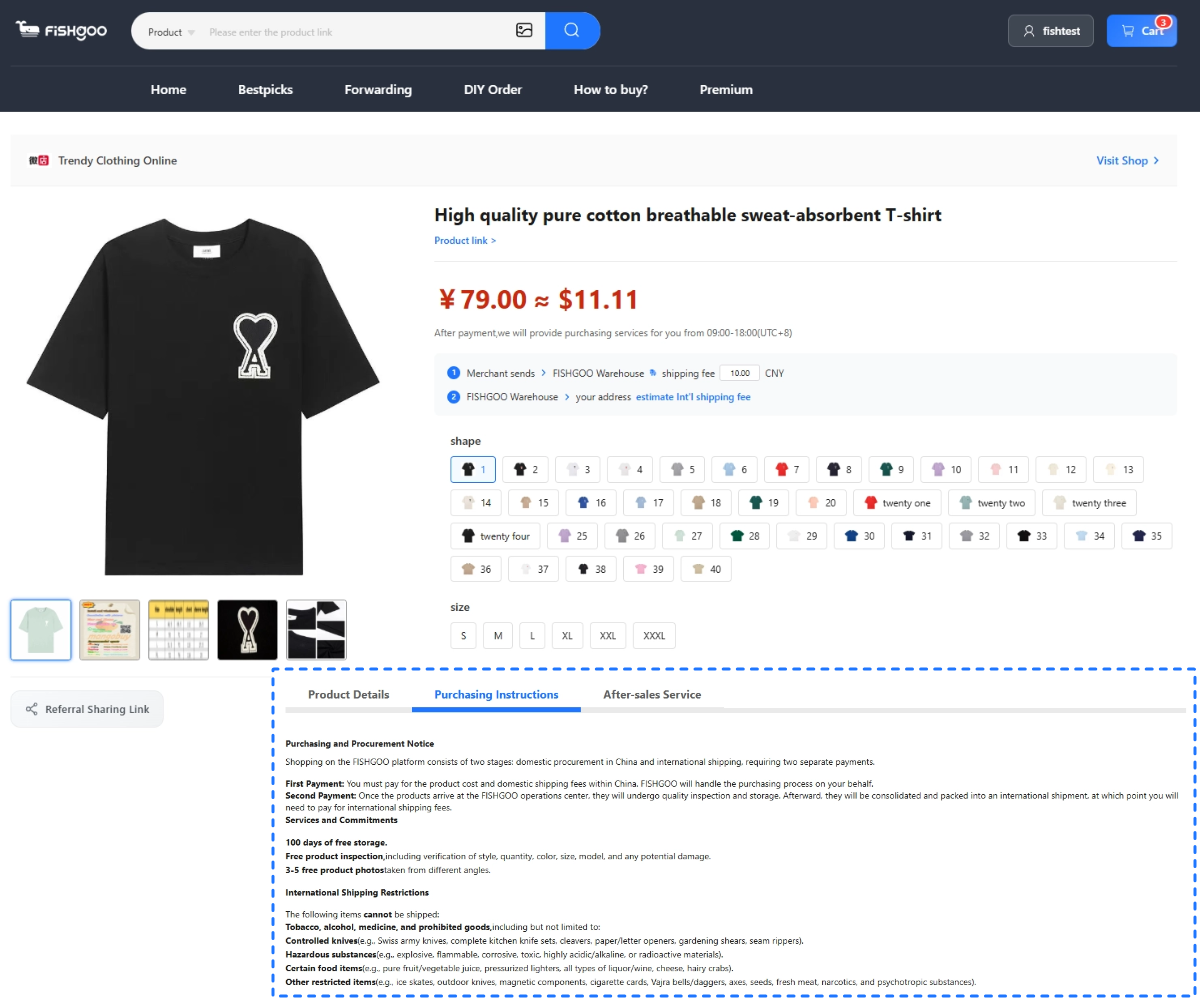
I say “mostly” because there’s one exception: some agents round product prices up slightly during conversion. Instead of showing you the exact ¥79 price as $10.97 (at real exchange rate), they might show it as $11.20 or $11.50. This is technically part of the exchange rate margin, but it starts at the product price display level, which makes it harder to catch.
How to verify: Open the original Taobao listing. Note the ¥ price. Divide by the current USD/CNY exchange rate (check Google: “1 USD to CNY”). Compare that number to what your agent shows. If the agent’s number is more than 2% higher, the markup is aggressive.
→ How the Taobao purchasing process works
Layer 2: Service Fee — The Visible Differentiator
This is the one agents compete on publicly. It’s a percentage charged on the product price as commission for the purchasing service.
| Agent | Advertised fee | On a $100 order | Annual cost ($2,000 spend) |
|---|---|---|---|
| Fishgoo | 0% | $0 | $0 |
| CSSBuy | ~3-4% | $3-4 | $60-80 |
| Sugargoo | ~5% | $5 | $100 |
| Superbuy | ~5% | $5 | $100 |
| Pandabuy | ~5% | $5 | $100 |
This layer is straightforward: zero is less than five. On a $2,000 annual spend, the service fee difference between Fishgoo and a 5% agent is $100 per year. That’s real money — enough for 2-3 extra hauls worth of products.
But here’s what most comparison articles miss: service fee is only one of four layers. An agent advertising “zero service fee” could theoretically recoup the difference through aggressive exchange rate markup or inflated shipping rates. That’s why you need to evaluate all four layers together, not just the headline number.
→ Full fee comparison breakdown
Layer 3: International Shipping — Visible but Complex
You see the shipping cost before you pay it, so it’s technically visible. But the pricing structure is complex enough that most buyers can’t tell whether they’re getting a fair rate or an inflated one.
How agents price shipping
Agents negotiate volume contracts with international carriers (DHL, EMS, China Post, YTO, etc.). These contracts give them rates significantly below what an individual shipper would pay. The agent passes through a portion of the discount to you and keeps a margin — typically 15-30% above their cost.
This is entirely normal and fair. The agent is providing a service (consolidation, customs documentation, carrier selection), and the shipping margin is one of their revenue sources. The question isn’t whether they add margin — it’s how much.
How to evaluate shipping fairness
Compare quotes across agents for the same parcel. Estimate your parcel weight (roughly 200-300g per clothing item, 600-900g per pair of shoes). Check 2-3 agents’ shipping calculators for the same weight to the same destination. If one agent consistently quotes 30-50% higher than others for identical routes, their shipping margin is aggressive.
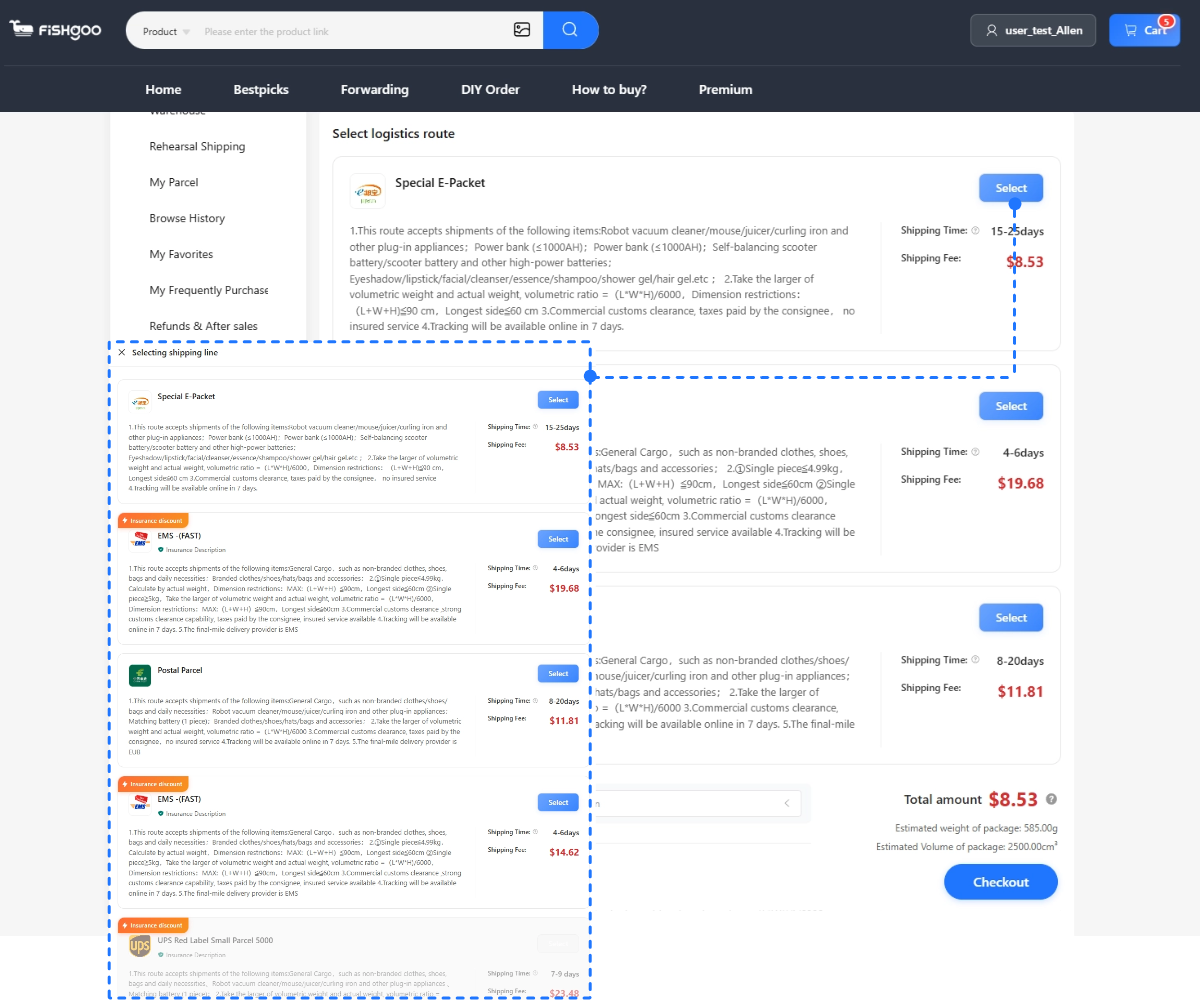
Check route availability. More routes = more competition = better rates for you. Fishgoo‘s 2,000+ routes mean you almost always have 4-6 competitive options for any destination. Agents with fewer routes give you less choice and less leverage.
Watch for “shipping insurance” auto-enrollment. Some agents automatically add $2-5 shipping insurance to your order. It’s opt-out, not opt-in, and easy to miss in the checkout flow. Check whether insurance is pre-selected before submitting your parcel.
→ Shipping methods and rates compared
Layer 4: Exchange Rate Margin — The Quiet One
This is the fee most people never notice. When you pay in USD (or EUR, GBP, AUD) and the agent purchases in CNY, there’s a currency conversion. The agent sets the conversion rate — and every agent sets it higher than the actual interbank rate.
The interbank rate is what banks exchange at. As of writing, roughly 1 USD = 7.20 CNY. If your agent converts at 1 USD = 7.05 CNY, they’re adding approximately 2.1% margin. That means your $100 product order actually costs you $102.10 before any other fees.
Let’s see how this plays out across different margin levels:
| Exchange rate margin | Cost on $100 order | Annual cost ($2,000 spend) |
|---|---|---|
| Fishgoo: contact customer service to confirm | Contact customer service to confirm | Contact customer service to confirm |
| ~2-3% (typical agent) | $2.00-3.00 extra | $40-60 |
| ~4-5% (aggressive agent) | $4.00-5.00 extra | $80-100 |
On a $2,000 annual spend, the difference between a 1.5% and a 4% exchange rate margin is $50-70 per year. Combined with service fee differences, the total cost gap between the cheapest and most expensive agents can reach $150-200 annually — on the exact same products purchased from the exact same sellers.
How to check your agent’s exchange rate
This takes 30 seconds:
- Note a product’s price in ¥ on the Taobao listing (example: ¥72)
- Google “72 CNY to USD” — this gives you the interbank rate (example: $10.00)
- Check what your agent charges for the same item in USD (example: $10.30)
- The difference ($0.30 on $10.00 = 3%) is the exchange rate margin
Do this once and you’ll know your agent’s typical margin. It doesn’t change often — agents set their conversion formula and keep it consistent.
Optional Add-On Charges
Beyond the four core layers, most agents offer paid add-ons. These are legitimate services with real costs — the question is whether you need them.
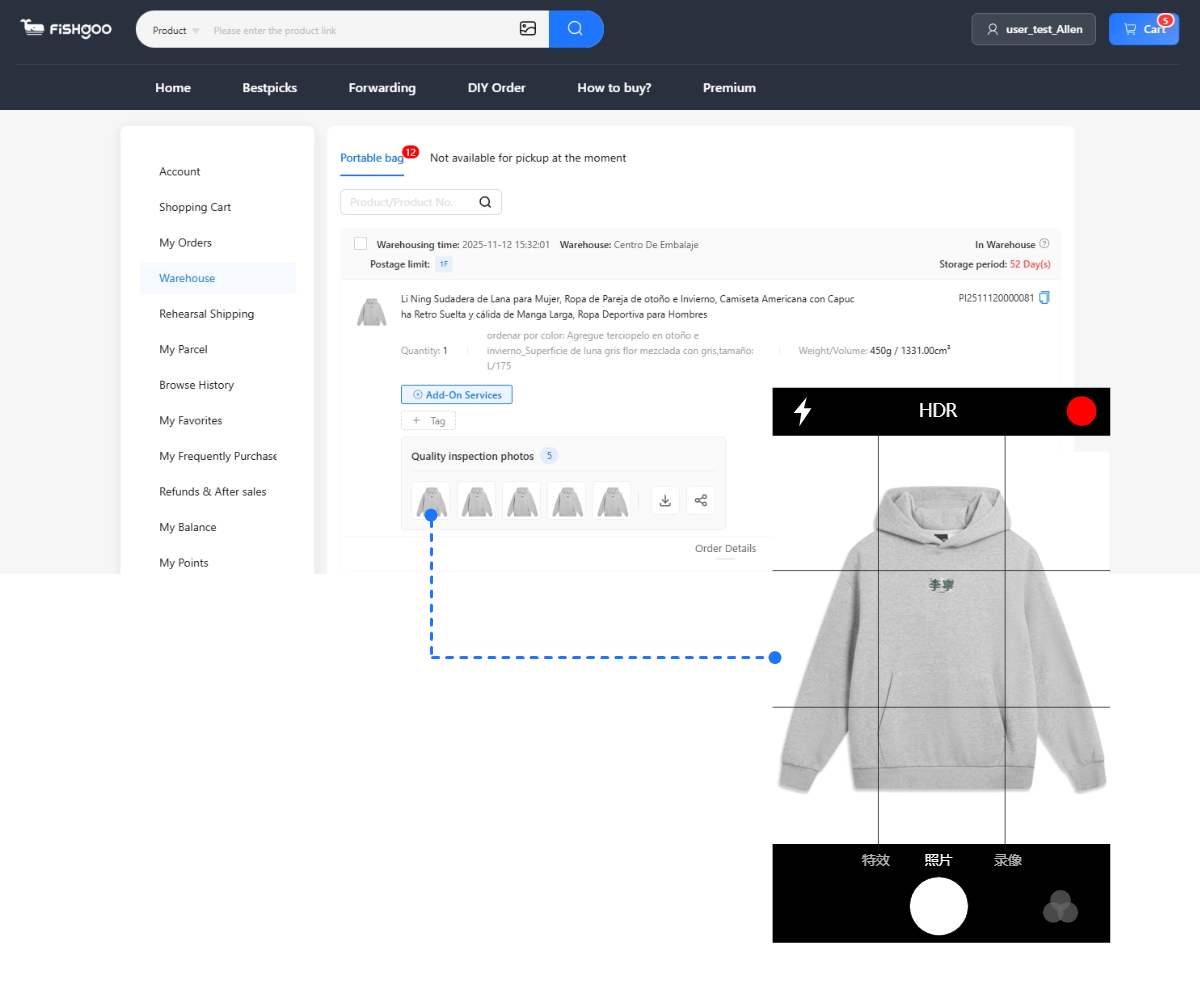
Extra QC photos. Some agents charge $0.30-1.00 per additional photo beyond the free allotment. Fishgoo includes 5 free HD QC photos per item — enough for thorough inspection in most cases. Agents offering only 3 free photos push you toward paying for the 4th and 5th.
Detailed measurement requests. Asking the warehouse to measure the actual insole length, chest width, or sleeve length of your item. Usually $0.50-1.00 per measurement. Worth it for items where size chart accuracy is critical — sneakers, tailored clothing.
Shipping insurance. $1-3 per parcel. Covers loss or damage during transit. Whether you need this depends on the parcel value. On a $50 haul, probably skip it. On a $200 premium haul, worth considering.
Priority processing. $2-5 to have your parcel consolidated and shipped before other orders in the queue. Only useful during peak seasons (post-11.11, pre-Christmas) when processing queues stretch to 3-5 days instead of the usual 1-2.
Vacuum packing / special packaging. $1-3 per parcel. Reduces volumetric weight significantly. Can actually save you more on shipping than the packaging costs, especially for bulky clothing items. Often a net positive expense.
None of these are hidden — they’re presented as options during checkout. The “hidden” cost risk comes from auto-selected add-ons you didn’t notice. Always review the order summary line by line before paying.
The True Total Cost: Side-by-Side Example
Let me build a complete cost comparison for a typical 10-item haul ($80 in products, 2.5kg, shipped economy to the US):
| Cost layer | Fishgoo | Agent charging 5% + 3% FX | Difference |
|---|---|---|---|
| Product cost | $80.00 | $80.00 | $0 |
| Service fee | $0 | $4.00 (5%) | +$4.00 |
| Exchange rate margin (~1.5% vs ~3%) | $1.20 | $2.40 | +$1.20 |
| Shipping (economy, 2.5kg) | $22 | $25 | +$3.00 |
| Add-ons (none selected) | $0 | $0 | $0 |
| Total delivered | $103.20 | $111.40 | +$8.20 |
$8.20 per haul doesn’t sound dramatic. But do 5 hauls per year and it’s $41. Do it for 3 years and it’s $123. And that’s on moderate $80 orders — on larger orders, the percentage-based fees scale proportionally.
More importantly: the $103.20 total through Fishgoo for 10 items delivered is still 50-65% less than what those same items would cost from AliExpress ($160-190) or local retail ($250-400+). Agent costs exist, but even with all four layers fully accounted for, the Taobao agent route remains dramatically cheaper than every alternative.
→ Full savings optimization with 9 tactics
How to Minimize Your Total Agent Cost
Five actions that push all four layers as low as possible:
1. Choose a zero-fee agent. Eliminates Layer 2 entirely. Fishgoo is currently the only major agent offering genuine zero service fee.
2. Check the exchange rate once. Compare your agent’s conversion to the interbank rate. If the margin is above 2%, you’re overpaying on Layer 4. Switch to an agent with tighter FX spread.
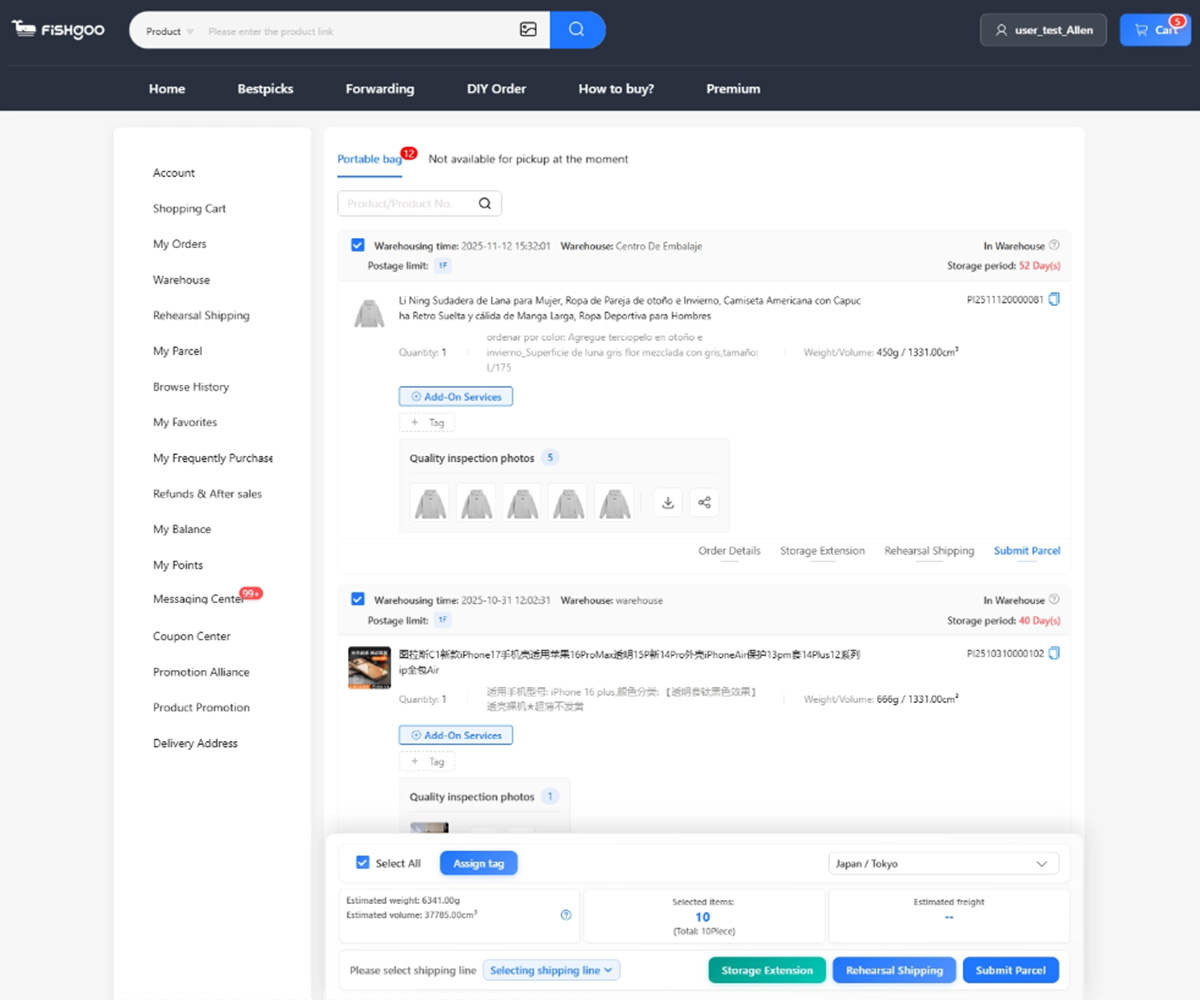
3. Consolidate 8-12 items per parcel. Spreads the Layer 3 shipping base rate across more items. Per-item shipping drops from $14 to $2-3.
4. Choose economy shipping. Reduces Layer 3 by 50-65% versus express. The speed difference is 10-15 extra days.
5. Review checkout line items before paying. Catch any auto-selected add-ons you don’t need. Deselect insurance on low-value orders. Skip priority processing unless you’re genuinely in a rush.
With all five actions applied, your agent-related costs on an $80 product order come to roughly $23 (Fishgoo: $0 fee + $1.20 FX + $22 shipping). That’s a 29% overhead on products — which sounds high until you remember that the alternative is paying 50-80% more on English-facing platforms where the overhead is baked into inflated product prices and invisible.
The Transparency Test
A trustworthy agent shows you every cost before you commit. Run this checklist:
- ✅ Service fee percentage clearly stated (or confirmed as zero)
- ✅ Shipping quote provided before you pay for shipping
- ✅ Product prices match original Taobao listing (within ~2% for FX)
- ✅ Add-ons are opt-in, not pre-selected
- ✅ No “processing fee,” “handling fee,” or vague charges on the invoice
If any of these fail, the agent is using opacity as a revenue strategy. Move to one that doesn’t.
→ Agent legitimacy verification
→ Is using a Taobao agent safe?
What does it cost to buy from China in 2026? The landed-cost formula
| Cost line | Who sets it | Typical behaviour | How to lower it |
|---|---|---|---|
| Item price | Seller | Chinese domestic price | Coupons and sale seasons. See Taobao coupons |
| Domestic shipping in China | Seller | Often free (包邮) or a few yuan | Buy several items from one store |
| Service fee | Agent | Fishgoo: 0% | Compare agents’ published fees |
| QC photos and storage | Agent | Fishgoo: 5 free QC photos per item, 100 days free storage | Use the free allowance to combine orders |
| International shipping | Shipping line | Charged by weight or volume, and varies by route | Combine orders, remove shoe boxes if it’s safe to, compare lines. Fishgoo has 2,000+ routes; contact customer service to confirm rates |
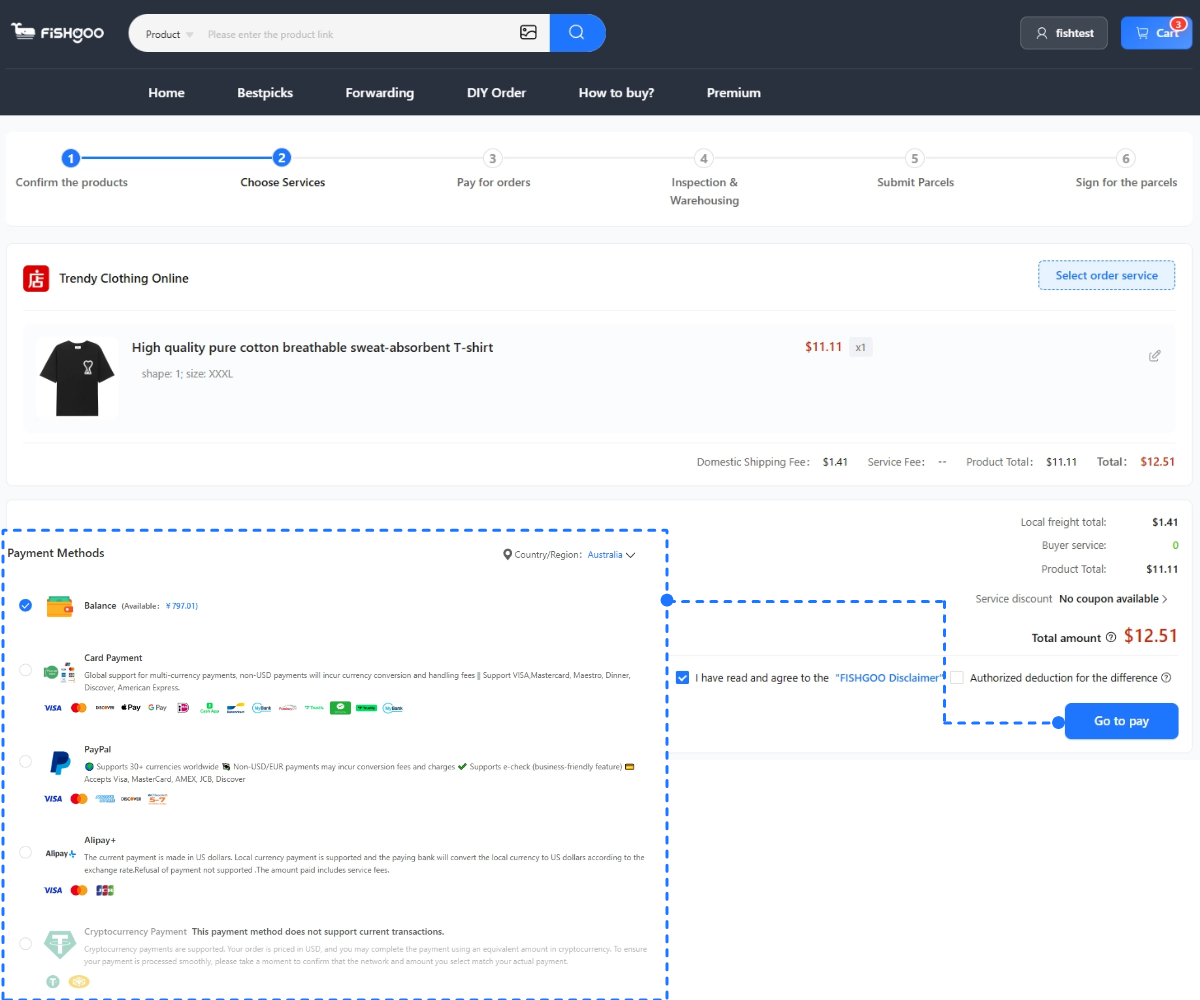
| Payment and currency | Payment provider or agent | Depends on the method | Compare methods; contact customer service to confirm |
| Import duty, VAT and handling | Your country | See the table below | Combine parcels; declare the real value |
Import charges by country (October 2026)
| Destination | Low-value rule | Tax | Notes |
|---|---|---|---|
| EU | Up to €150: flat €3 duty per product category (since 1 July 2026) | Local VAT, e.g. 19% in Germany, 21% in the Netherlands | €2 EU handling fee per declaration line expected from 1 Nov 2026; carriers may add their own fees |
| UK | Up to £135: VAT charged at the point of sale | 20% VAT | Above £135, VAT and duty at import |
| US | No duty-free de minimis (suspended) | Duties depend on the product, including China-specific duties | Postal entry rules change from 22 Oct 2026; check with your agent |
| Australia | Up to A$1,000: GST collected at the point of sale | 10% GST | Above A$1,000, duty and GST at import |
Country guides: Europe, UK, USA, Australia, Canada. Estimate shipping with the China shipping cost estimator.
Worked example: a ¥600 haul to the Netherlands
Five items totalling ¥600 (about €75), from two stores, with free domestic shipping, in two product categories. International shipping is your quote, written as S here.
| Line | Amount |
|---|---|
| Items | ≈ €75 |
| Fishgoo service fee | €0 (0%) |
| QC photos (5 per item) and storage | €0 (within the free allowance) |
| International shipping | S (your quote) |
| Duty | €6 (2 categories × €3) |
| VAT 21% | 0.21 × (75 + S + 6) |
| PostNL handling, if charges are collected on delivery | €10 |
Source for the Dutch rules: Dutch Customs (douane.nl) and PostNL, checked in October 2026. Full walkthrough: Taobao to the Netherlands.
Can you avoid customs fees when buying from China?
Not legally by under-declaring. That risks fines, delays and seized parcels. What you can do legally:
- Combine orders so fixed per-parcel fees are paid once.
- Keep categories in mind where duty is charged per category, as with the EU’s €3.
- Check where the thresholds fall (€150, £135, A$1,000) before adding the last item.
- Use lines that prepay duties (DDP) where available. See DDP shipping explained.
FAQ
How much does it cost to buy from China through an agent?
Item price + domestic shipping + any service fee (Fishgoo: 0%) + international shipping + payment costs + import duty and VAT in your country. Shipping and import rules are the biggest variables.
How can I avoid customs fees buying from China?
You can’t legally avoid them by under-declaring. You can reduce them by combining parcels, watching value thresholds and product categories, and using duty-prepaid lines where available.
Is there still a €150 duty-free limit in the EU?
No. Since 1 July 2026, parcels up to €150 pay a flat €3 duty per product category, plus VAT.
-
Is “zero service fee” a marketing trick?
Not at Fishgoo. The service fee is genuinely zero — the $0 line item is real. For the exchange rate and payment costs that apply to your order, contact Fishgoo customer service to confirm. The total cost comparison confirms this — Fishgoo’s all-in price consistently comes out lowest.
-
Which cost layer matters most?
Shipping (Layer 3) is the largest absolute cost. Service fee (Layer 2) and exchange rate margin (Layer 4) are the most controllable — you can eliminate or minimize both by choosing the right agent. Product price (Layer 1) is fixed by the seller.
-
How much does the average Taobao buyer actually spend on agent costs?
On a zero-fee agent like Fishgoo, shipping is the main variable; for current rates and payment costs, contact Fishgoo customer service to confirm. On a 5% fee agent with similar shipping: $25-35 plus $4-8 in fees and FX margin. Annual difference for a regular shopper: $50-150.
-
Should I worry about exchange rate margins?
Check it once. If your agent’s margin is below 2%, it’s competitive. If it’s above 3%, you’re paying a premium that compounds over time. Most established agents fall in the 1.5-3% range. For Fishgoo’s current rate, contact customer service to confirm.
-
Are there any completely hidden fees I might miss?
The main one people miss is exchange rate margin — it never appears as a line item. Auto-selected insurance is the other common surprise. Beyond those, legitimate agents don’t have hidden fees. If you see unexplained charges on an invoice, contact the agent’s support and ask. If they can’t explain a charge clearly, that’s a red flag.
→ See the real cost yourself — Fishgoo zero fee, transparent pricing


Start with one product, sample or restock task
Send the product link or description, approximate quantity and destination. Review the scope before any paid purchasing work begins.